Category Archives: Baserunning
What happens when old men demonstrate slidebys
Just had to share this photo. One week ago today I was explaining to our 14U Glory team about not sliding or running into a tag, especially at home. Instead, I said, if the ball beats you there use a slideby. 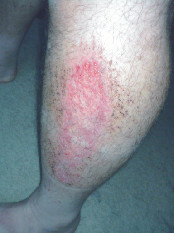
Knowing, however, that many people learn better by seeing than hearing, I positioned a catcher at home with the ball, strolled up the third base line, and then took a run at the plate. (I was wearing shorts at the time, incidentally.) As I approached the catcher I got out wide, beyond her reach, executed the slideby and touched the plate with one finger. Safe!
When I stood up to review what I’d just done, one of the girls pointed out that I was bleeding. I didn’t think much of it, but we took a break while I cleaned it off.
Turned out to be worse than I thought at first. In fact, the photo you see here is after a week of “healing.” It’s made for a great war story though, and it definitely demonstrated that I won’t ask my players to do anything I wouldn’t do.
Still, you’d think I’d know better. Old men, especially fat ones, and sliding are not a good combination. I have to think that the added weight didn’t do me much good as I tried to “glide” across the infield dirt.
In any case, while it looks bad I am fine. I’ve been wearing two 3″ x 4″ gauze pads over the area for the last week, changing them each morning before I head to work. It’s not as bad as it was, but I have a feeling I’ll be showing this particular scrape in some form for a few more weeks. Oh well, all for a good cause.
Gaining an advantage on base
In fastpitch softball, it’s not always easy to get runners on base. That’s why you need to take advantage of the situation as much as you can.
Many coaches like to bunt as soon as they get a runner on base, giving up an out to advance the runner 60 feet. As regular readers know, I’m not a big fan of that, especially since it only increases your chances of scoring by two percent.
Still, it would be nice to get that runner moved. So how do you do it? Sometimes you have the hitter bunt for what hopefully turns out to be a hit. That takes a lot of practice and a lot of discipline. But there is another way. You can take advantage of the pitcher.
The key is your baserunners have to change the way they watch the game. Most runners tend to take their leads, and then watch to see what happens at the plate. That’s too late. Instead, they should be watching the pitch out of the pitcher’s hand and taking advantage of what they see.
For example, if the pitcher has a great change a baserunner who can recognize it can bolt immediately for the next base as soon as they recognize it, hopefully before it’s halfway to the plate. What does that do?
Consider a pitcher throwing 55 mph, with a 40 mph change. While that change is on its way to the plate, the runner is running, and there’s nothing the catcher can do until the ball makes its way there. Do that a couple of times on changeups and not only are you likely to advance some runners for free, your hitters probably won’t have to worry too much about a change of speed when there are runners on base.
Another thing to watch for is the pitch that’s on its way to the dirt. It’s good if your hitters recognize when a ball is hitting the dirt and take off. It’s better if they realize halfway there that it’s going to hit the dirt and take off before it actually happens. It may throw the catcher off, forcing her to try to throw the ball before she has it. If it doesn’t, she still has to block it and then make the throw on a runner who is 10-15 feet further than she would’ve been if she waited.
It definitely takes some practice, but it’s worth the effort. Just remember to reward your runners for their aggressiveness!
Thinking a base ahead
Since we had the weekend off I had a chance to watch some games at a younger level — 12U specifically. After coaching high schoolers the last few years it was interesting to take a step back and see what was missing.
Probably one of the most glaring things was how the young kids run the bases. For many, running the bases meant getting to the next base, i.e. if the runner was on first her whole focus was on getting to second. The problem with that was once she got there, her mission was accomplished. Never mind that the ball was being thrown elsewhere, and there was an opportunity to get to third. She’d done her job.
Now, this wasn’t universal. There were definitely some teams that ran the bases better. But for the most part it was a skill or knowledge level that wasn’t there.
What I see in all this is an opportunity. When you’re coaching a younger team it’s often difficult to decide what to teach first. There’s so much to know you can’t possibly cover it all, even in one year — especially when you have to go back and repeat things to make sure they sink in. But if you want to do something that can have a quick payoff, work on baserunning.
Make sure your young players understand that the objective is to make it all the way home. The faster they can do that the more you will score. (Remember that they may not understand the big picture of scoring as many runs as you can. It seems simple but it may not be to a youngster just learning the game.)
Make sure they understand that they should never settle for one base if they can get two, or settle for two bases when they can get three. Make sure they realize things can be happening all over the field, and thus they need to pay attention to what’s going on around them. The more you can get them thinking aggressively, the less work you’ll have to do to score each run. And the more you’ll be able to take advantage of your opponents’ mistakes.
By the way, your team might not be that good at it right now, but they will learn it. Mine didn’t know it either once upon a time. But they did learn it — and in a tight game the team that can run smart gives itself a much better chance of winning. You can take that to the bank!
Making the call on tag plays
Maybe it’s just coincidence, or maybe I’m just noticing it more. But it sure seems like umpires are judging tag plays more by when the ball arrives than by whether a tag is applied.
I saw it several times over games the last weekend. On a few bang-bang plays going into bases, the ball arrived, the runner slid in, and the umpire called the runner out. The problem is the tag was applied after the runner’s foot was on the base.
My friend and assistant Rich says making the call that way is the easy way out. You don’t have to see what actually happens, or focus on the entire sequence. You just look for the ball to come in around the same time as the runner and call the runner out.
Now, I could be wrong about it. All those runners could’ve been out. But I don’t think so. I’m pretty good at judging these sorts of things with a fairly unbiased eye, and I know what I see.
What do you think? Are umpires depending more on the arrival of the ball than seeing the entire play through? Or is it my imagination?
Getting a better jump on steals
 Have you ever sat in the dugout watching a team loaded with kids with world class speed and wished your team could run that fast? You think boy, if we could run like that we’d be stealing bases all the time.
You actually don’t need that kind of speed to steal bases. We confirmed that this weekend when we tested out something my pal Rich and I learned at the NFCA Coaches College.
My team is not exactly gifted with speed. As a result, we tended not to attempt many steals. We’d either have to bunt, hit or wait for a wild pitch to advance a runner. But at the Coaches College, they suggested videoing your team while they tried to get off the base on a steal. (Obviously you do this during practice.) We did it, and even told our girls to try leaving early. Then we watched the video on my computer.
What we (and they found) was not only weren’t they on time, they were actually very late. It was no wonder we weren’t very successful. So now that they understood the timing, we worked on getting a better jump. Sure enough, this past weekend we were successful on roughly 7 of 9 steal attempts. The nine attempts probably was more than we tried all last year. It was an amazing turn around.
If you have access to a video camera, give it a try. You may find it opens a whole new level of offense for you. You don’t need to be fast. You just need to get going at the right time.






 Life in the Fastpitch Lane