Help for Pitchers Who Are Banging Their Elbows Into Their Hips

It’s more common than you might think: pitchers, especially those who are trying to keep their pitching arms in close to their bodies (as they should) suddenly start feeling slight to intense pain as they go into release. Once it catches their attention, they realize their elbows are hitting their hips. HARD.
Well-meaning coaches, other pitcher parents, and even some random people will tell them to solve the issue they should clear their hip out of the way or bend out more so their arm totally misses their body as they go into release. While yes, that will solve the immediate issue, it will also create less-than-ideal mechanics that will ultimately limit most pitchers’ ability to compete at a high level.
That’s because compression of the upper arm against the ribcage and light brush contact of the forearm are both essential to stabilizing the shoulder complex to prevent a more serious injury, transfer more energy into the ball to improve speed, and sure consistency of release to improve pitch accuracy/command.
By now you may be asking if that’s the case, why is my pitcher/daughter getting giant bruises on her elbow area and/or hip area while other pitchers are not? The simple answer is because those who are not raising those ugly bruises are making contact differently than those who are.
The bruises are coming from the position the arm and hip are in going into release.
When the bruises are happening, the elbow are is making direct contact with the pelvis (hip bone), crashing into it in a bone-on-bone manner. When they’re not happening, the pitcher is making contact with with the soft tissue (muscle) on the forearm just below the elbow into the muscle (soft tissue) on the side of the hip, interrupting the acceleration of the arm enough to transfer the energy without stopping it completely.
So what causes the elbow to slam into the hip instead of passing by it? I find that typically there are two causes, which can happen either independently or in the worst cases at the same time. Correct those and the problem usually goes away,
Cause #1: Staying Too Open
Every pitcher needs to open her shoulders and hips (externally rotate) to some extent to create an aligned, powerful arm circle. The shoulder in particular is important because when you are facing straight ahead, the arm can only come back so far before it has to deviate off-line.
This deviation stresses the shoulder, leading to injury, and takes the arm out of its ideal movement around the shoulder, affecting both speed and accuracy. Opening the shoulders makes in possible for the arm to move around at incredible speed while using the shoulder the way it’s designed to be used.
The problem occurs when the hips and shoulders don’t come back forward to an area around 35-50 degrees going into delivery. The body then starts blocking the arm, and the pitcher either has to then go around it or slam her elbow into her hip.

Think about where your elbow is when you are just standing normally. It sits squarely on your hips. If it does that while you’re standing still, what makes you think it won’t do that when you’re aggressively trying to throw a pitch.

The cure for this is to move into that 35-50 degree angled range we mentioned earlier. When you are in this position, even standing, your elbow is clear of your hip while allowing your forearm to still make light brush contact with the side of your hip as it passes the hip.
To learn that, have the pitcher do a ton of easy walk-ins, where she starts out facing the plate, then takes an easy step with her throwing-side foot before going into the pitching motion. She should do this slowly, with no leg drive at all, and focus on moving her body open with good external rotation of the shoulders and then back into a roughly 45 degree position.
On the field you can throw a regular ball from a short distance. But at home, have her look into a mirror as she does the movements without a ball, paying attention to how her body is moving and coming back to the finish position.
Ideally, her hips will move a little ahead of her shoulders as she comes down the back side. Once she can do it without a ball, have her throw a rolled up pair of socks or a lightweight foam ball into the mirror, again paying attention to how her body is moving.
You get all the benefits of brush contact while maintaining solid posture (no contorting to move the hips out of the way or throw the shoulders too far off) so the pitcher can pitch pain-free.
Cause #2: Keeping an Arch in Your Back
The second major cause of banging the elbow into the hip in a way that causes injury is having your back arched backwards going into release. This can happen even if you are getting to the 35-50 degree position we talked about above.
At the top of the circle, it is desirable for a pitcher to have her back arched back at least 15 degrees toward first if the pitcher is right-handed or toward third if the pitcher is left-handed. It’s a movement that helps load the muscles in the back so they can help accelerate the arm on the way down. It also helps getting proper external rotation and keeping the arm on-path.
After the peak of the circle, however, the arch should come out and the pitcher should be in some level of flexion by the time she is going into release. In other words, she will be slightly bent toward third if right-handed or toward first if left-handed.
If the arch doesn’t come out, however, it pulls the pitching elbow backwards instead of letting it flow freely through its natural path. When that occurs the pitcher will either bang her elbow into the side or even back of her hip.
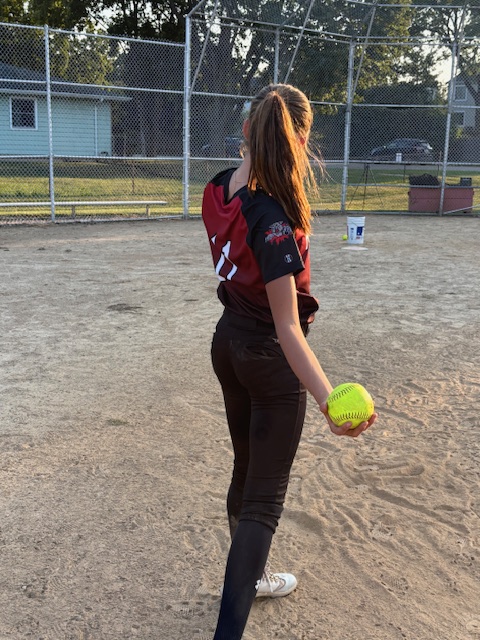
She may also try to compensate for this bad position by trying to move her elbow away from that area, causing her to throw low and very inside, which will make pitching even more difficult than it already is.
To solve this issue, the pitcher needs to learn how to come out of the arch as her arm comes down the circle. One way to do that is to have her practice throwing a pair of rolled up socks into a mirror, watching herself to see what position her body is in when overhead and then when releasing the socks.
She should see herself arching at the top then flexing in at the bottom. You can even put a piece of tape on the mirror to help her see it. Have her start slowly, then build her speed until she can execute it without thinking.
Another way to address this issue is a drill I got from Rick Pauly of PaulyGirl Fastpitch called the Bow-Flex-Bow. For this one you will need a piece of Theraband that is at least as long as the pitcher’s arm.
Have her grab both ends of the Theraband and stand at a 45 degree angle, as if getting ready to do a pitching drill. She then takes the Therabad up and into a pitching motion, with both hands moving forward toward the “plate” before starting to separate overhead.
When she is at the top of the circle her back will need to arch to get the Theraband behind her head. As she comes down, make sure she bows back in to come to the finish so instead of arching/flexing back she is now flexing forward.
Baby and Bathwater
No question that banging your elbow into your hip is not only unpleasant but counter-productive for achieving both speed and accuracy. But totally avoiding any contact between the body and the arm isn’t the way to go either.
The issues listed here aren’t the only reason it can happen but they are the two most common. By making the corrections to achieve proper upper arm compression and light brush contact you can stop the pain while improving performance.

Posted on September 12, 2025, in Pitching and tagged arching back, banging elbow, bow-flex-bow, brush trigger, compression, elbow bruise, PaulyGirl Fastpitch, pitching pain, Rick Pauly. Bookmark the permalink. Leave a comment.






 Life in the Fastpitch Lane
Leave a comment
Comments 0