Checkmate! Why Fastpitch Hitting Is Like a Chess Match

Ok, before we begin I am going to flat-out admit I am not much of a chess player. I never liked it as a kid – too slow and boring for me – and can’t remember the last time I played a full game.
Probably when I was in high school, which was a very looooooong time ago.
But I do know enough about it to understand how it’s played from a macro level. Especially after watching The Queen’s Gambit series.
At its core, chess is a game of strategy and anticipation. You don’t go for the kill right away.
You make certain moves in a particular order to put yourself in a position to strike when the chances of success are highest. And you anticipate what your opponent is going to try to do to disrupt that strategy.
In that way it’s a lot like hitting.
The instinct of many young hitters (and more than a few older ones if we’re being honest) is to attack the ball with their bat as soon as it’s pitched. In other words, they initiate the swing with their hands and let the body follow that lead.
That can work sometimes. After all, a broken clock is right twice a day (unless it’s digital, in which case it probably doesn’t work at all) and a blind monkey can find a banana now and then.
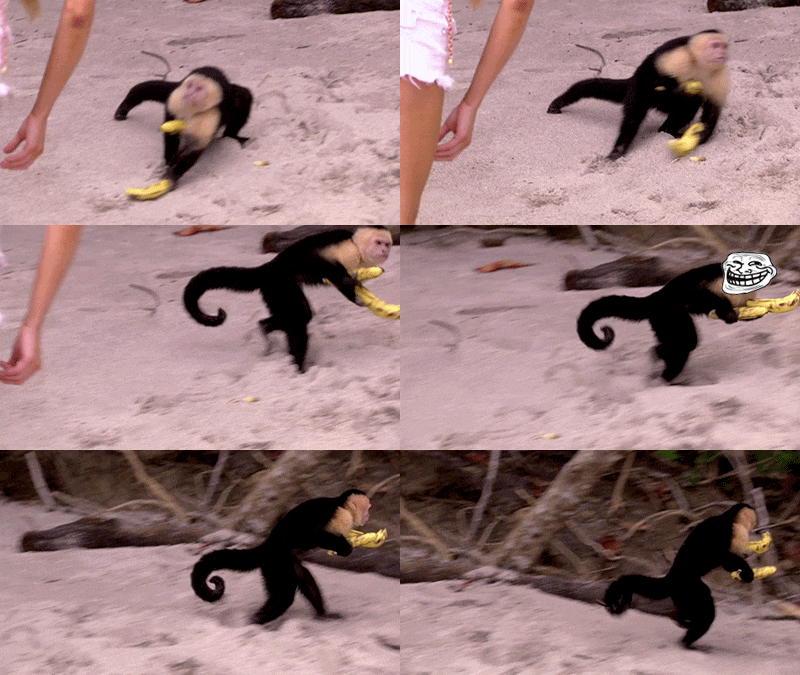
It is not, however, an approach that is going to yield regular success, especially in higher levels of play.
Just like in chess, the first move shouldn’t be the main attack. It should be to get the pieces in place so when you do attack the ball you stand a better chance of hitting it.
That’s why a sequence of hips-shoulders-bat after the front foot lands is so important.
The hips have two jobs. The first is to generate power.
The largest and strongest muscles in the body are located in the lumbar-pelvic-hip complex (LPHC). The rotational movement of the hips and core muscles get the body moving in a manner that accelerates as it goes, creating power that can then be transferred up the chain when those same muscles suddenly decelerate the hips.
By delaying the shoulders momentarily, instead of allowing them to ride along with the hips, you create a stretch from the front hip to the back shoulder that acts as a rubber band, helping accelerate the shoulders and ultimately the bat forward rather than using the arms to do it. This frees the arms and hands to focus on directing the bat to the ball rather than yanking it wildly to try to increase the energy.
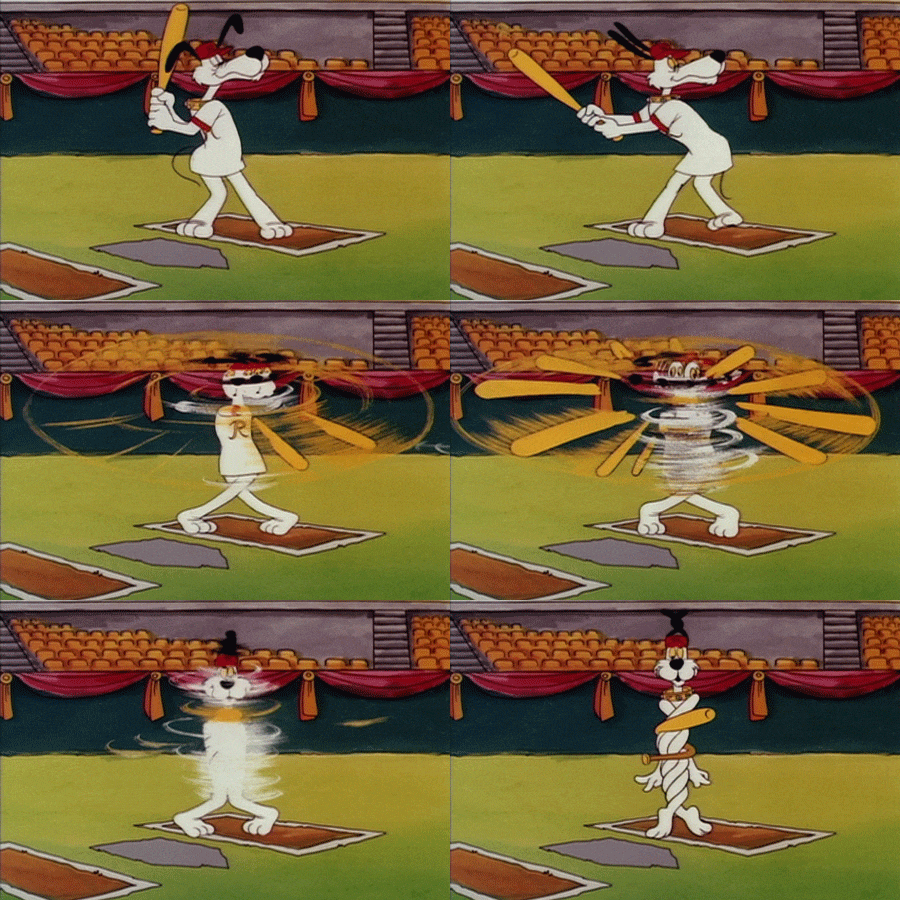
But it’s not just about power. That same movement also helps position the upper body, bringing it to the launch position without having to commit the arms and bat to the ball.
This delay give the hitter more time to see the ball and brings the bat closer to it so the actual launch of the bat occurs over a shorter distance, increasing the chances of making good, hard contact. After all, it’s easier to hit a target from close-in than far away, particularly if it’s not exactly coming in on a straight line.
And that’s where the chess analogy comes in. Rather than rushing the swing, an effective, quality hitter will first get all the pieces in place, then unleash the swing with a controlled explosion when the time is right.
Whereas a weaker hitter will place all her focus on simply getting the bat to the ball from the beginning of the swing.
The other part is the strategic element, the cat-and-mouse game between the hitter and the pitcher. A good pitcher will either be trying to pitch to her strength or the hitter’s perceived or known weaknesses so the hitter must understand what those are and adjust accordingly.
For example, if the pitcher is heavily dependent on her riseball to get hitters out, the hitter must have a strategy to deal with it. That can be to try to stand a little taller and stay on top of it, or look down and lay off those riseballs entirely while hoping the umpire doesn’t have a high strike zone.
The hitter can also look for patterns in the pitch caller’s pitch sequences. For example, if the pitcher is throwing changeups consistently in 0-2 counts, the hitter should be looking for a changeup if she goes 0-2.
In fact, against a tough pitcher she may concede the first two strikes to get to that easier to hit changeup. I’ve seen that work.
Hitters need to be aware of their own weaknesses as well. If a hitter has trouble with outside pitches, and is playing against an opponent who knows that, she should expect a steady diet of outside pitches until she proves she can hit them.
In that case, the strategy might be to crowd the plate and turn the outside pitch into more of a middle pitch – particularly if the hitter is strong on inside pitches. Doing that might even bait the other team into throwing inside to try to handcuff her – at which point she can turn on a pitch she likes and send it off like a rocket.
This is what makes fastpitch softball hitting so interesting and challenging. While it definitely requires a high element of physicality, there are also strategic elements built in that will affect and are affected by the physical components.
No wonder hitting has been called the most difficult feat in all of sports.
So keep that in mind when you’re working with hitters of all ages, levels, and abilities. Have a strategy for how you’re approaching each pitch, and a plan for how you’ll move the pieces in place to execute that strategy, and you’ll greatly increase your hitters’ chances of success.
Checkmate!
My good friend Jay Bolden and I have started a new podcast called “From the Coach’s Mouth” where we interview coaches from all areas and levels of fastpitch softball as well as others who may not be fastpitch people but have lots of interesting ideas to contribute.
You can find it here on Spotify, as well as on Apple Podcasts, Pandora, Stitcher, iHeart Radio, or wherever you get your podcasts. If you’re searching, be sure to put the name in quotes, i.e., “From the Coach’s Mouth” so it goes directly to it.
Give it a listen and let us know what you think. And be sure to hit the Like button and subscribe to Life in the Fastpitch Lane for more content like this.
Chess photo by Gladson Xavier on Pexels.com

Posted on April 4, 2025, in Hitting and tagged chess, fastpitch hitting, moving into position, strategic thinking, The Queen's Gambit. Bookmark the permalink. Leave a comment.






 Life in the Fastpitch Lane
Leave a comment
Comments 0