Monthly Archives: April 2025
The Power of a Kind Word (or Two)

A couple of nights ago one of my hitting students, we’ll call her Persephone (for no reason other than it amuses me), came in for her first lesson in a few weeks. She is playing high school ball right now and has been tearing it up for the most part, but Persephone has had a little less success lately and decided it was time for a tune-up.
Her dad walked in before her and gave me a heads-up that Persephone had had a rough game that night, going 0-3, and was also having a little family-based teen angst on top of it. Always nice to have some warning in those cases.
When Persephone came in (wish I’d picked a name that is easier to type) I could see her mental state was no minor issue. She was an emotional pot ready to boil over.
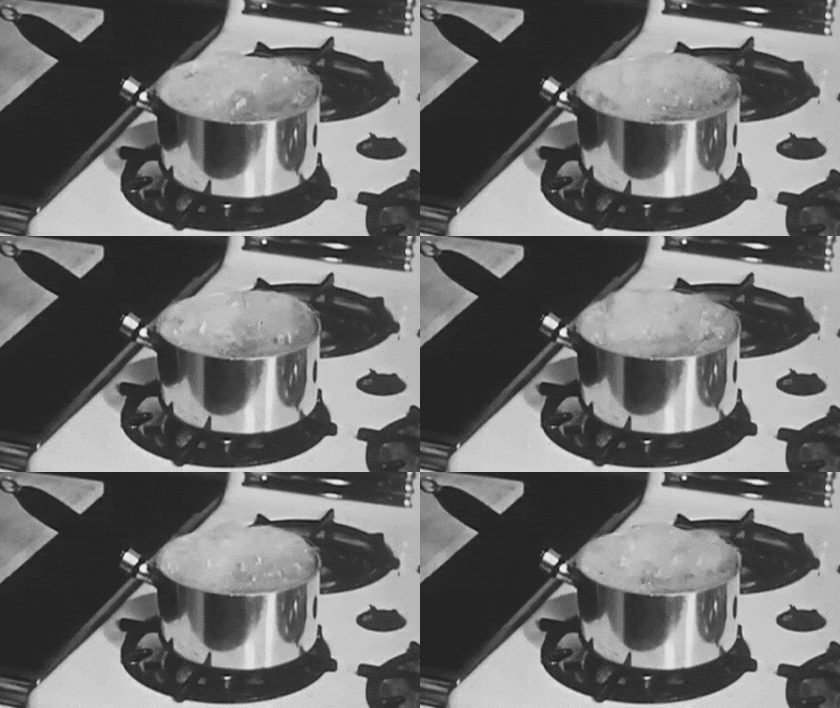
She was trying to keep the lid on it, but it was rattling pretty hard. Most of the time she is a pretty even-keel, laid back young woman but even the toughest among us can get overwhelmed at times, and that’s what was happening here.
We started into the lesson and I asked her about the game. She told me she just couldn’t hit the pitcher, and in particular was unable to touch her curveball. Persephone told me she was swinging and missing it by quite a bit.
Her dad had told me in the beginning that it wasn’t just Persephone who had that trouble that night; the opposing pitcher was one walk shy of a perfect game. But Persephone is a team leader who sets high standards for her performance, so it didn’t matter to her that everyone else struggled; she felt she could have and should have hit that girl anyway.
I talked to her some about the mental game, staying focused on the process instead of outcomes, keeping it simple, how to relieve stress at the plate, all of that. It helped somewhat.
When I went to front toss I identified a mechanical flaw too – she was pulling her front side out instead of hitting around it, so it’s no wonder she couldn’t touch those outside curveballs. She made the correction and started hitting a little better, but I could see she was still in her own head too much.
Then the miracle happened.
There was another hitting instructor doing a lesson in the cage next to us. His name is Dave Doerhoefer, and we have known each other for more years than either of us probably cares to admit.
Dave is a friend as well as a great coach, and we often have chats about the current state of the sport, especially when it comes to teams playing too many games and not practicing and teaching enough.
He was working with his student on firming up her front side as she went into rotation instead of letting it collapse but she was having trouble grasping the concept. His line of sight took him directly toward our cage and he saw how hard Persephone was swinging the bat and how sweet her technique was, so he asked Persephone if his student could watch her a few times because she has such a nice swing.
It was literally like the clouds had parted and the sun was doing a happy dance in her heart.

Dave’s question totally pulled Persephone out of her self-inflicted funk and her face just lit up. Then she started lighting up my front toss pitches too – including the outside ones.
That one simple question, which was also in effect a great, unsolicited compliment from someone that had no stake in the process but just liked what she was doing, turned Persephone’s entire approach around.
Later I thanked Dave for his kind words and told him what it had meant to Persephone. He shrugged and thanked me for telling him that, but admitted he had no motivation in it other than wanting his student to see another hitter doing what he wanted her to do in real time.
Now, I will say Dave may come to regret his kindness because in addition to being a hitting instructor he is also a varsity softball coach at Vernon Hills High School, and his team may play Persephone’s somewhere along the way – perhaps the State playoffs. But I’m sure he’s ok with it because Dave’s #1 focus is on helping fastpitch softball players get better, no matter if they are his or his opponents’.
The point here is it didn’t take much to make Persephone’s day and help her go from feeling bad about herself when she came in to walking on air with a big smile on her face when she left. You have the power to do the same.
When you’re at the field and you see someone do something great, whether it’s a driving big hit or making a diving catch or throwing a knee-buckling changeup or making a heads-up slide, don’t just admire it to yourself. Find that girl after the game and tell her – even if she’s on the opposing team. That goes for parents as well as coaches.
You never know what someone else has been going through, and those few kind words may be just the inspiration they need to keep fighting and overcome their struggles. It only takes a few seconds, but the ripple effect from that encounter might just alter the trajectory of a life in a positive way, even if just by a few degrees.
And the best part? Offering up a sincere compliment now and then doesn’t cost you anything but a little thought and time.
I know some of the happiest stories my students tell me are when an opposing coach or parents tells them they did a great job. So this weekend, get out there and if you see something good say something good about it.
You never know who needs to hear it.
My good friend Jay Bolden and I have started a new podcast called “From the Coach’s Mouth” where we interview coaches from all areas and levels of fastpitch softball as well as others who may not be fastpitch people but have lots of interesting ideas to contribute.
You can find it here on Spotify, as well as on Apple Podcasts, Pandora, Stitcher, iHeart Radio, or wherever you get your podcasts. If you’re searching, be sure to put the name in quotes, i.e., “From the Coach’s Mouth” so it goes directly to it.
Give it a listen and let us know what you think. And be sure to hit the Like button and subscribe to Life in the Fastpitch Lane for more content like this.
Lead photo by Pixabay on Pexels.com
6 Benefits of Playing Under Sandlot Rules

Let me start by acknowledging that today’s ballplayers are far more technically skilled and athletically knowledgeable than they were when I was young lad, and even when I started coaching more than 25 years ago. If you go out to a ballpark this weekend, even to a local B-level or C-level 10U tournament, you’re likely to see a higher level of overall performance than you would have even 10 years ago.
Don’t even get me started on how crazy good high school and college softball players are today.
We can attribute a lot of that growth, in my opinion, to the tremendous amount of information that is available to coaches today as well as the tremendous amount of time teams and individuals invest in structured, organized training sessions and practices. With competition levels already high and improving each year, you’re either getting better or getting left behind.
Yet for all their technical prowess, I think today’s players may be missing out on a few things that are equally important to their level of play – and probably more important to their development as human beings: the benefits of playing under what’s called “sandlot rules,” i.e., unstructured playtime.
Following are some of the benefits that could be gained by downsizing the organized team activities (OTAs) and giving players more time to play under “sandlot rules.” And not just softball but whatever games those players want to play at the time.
1. Acquiring decision-making capabilities
In OTAs, coaches or other adults decide what players are going to do pretty much every minute of every practice or game. They determine who’s going to play where, what order they will bat in, what strategies they’re going to follow, even what uniforms to wear, right down to the color of socks.
Under sandlot rules all of those decisions have to be made by the players themselves. They pick the teams (if teams are needed), agree on the rules, determine what equipment is needed, set the boundaries for play, etc.
Whatever needs to happen to get game or activity going, players get to decide on them. If they can’t decide, that leads to the benefit of…
2. Learning conflict resolution
Let’s say the players want to play a game of softball, but there are no lines on the field. A batter hits a ball down the line and the defense says it’s foul while the offense maintains it was a fair ball.
With no umpire to look to, the players on both sides will have to come to a conclusion. If neither side can convince the other of its position, the likely outcome is the ol’ do-over.
No matter what they determine, however, they will have worked the problem and decided on an outcome. Or they won’t agree on one, in which case the game is probably over and no one gets to play anymore.
Either way, they will have learned a valuable lesson about the value of cooperation and compromise to achieve a higher goal (in this case continuing to play).
3. Developing problem-solving skills
Certainly the situation in point #2 also involves an element of problem-solving too, but I’m thinking of more general problems for this benefit.
For example, let’s say there are enough players to have 7 on each side. But a full team requires 9 on each.

When I was a kid and that was the case, we would close an outfield section (usually right field except for me, who hits left-handed) and have the team on offense supply a catcher. It was understood that the supplied catcher was obligated to perform as if he was a member of the defensive team and do all he could to get the out if there was a play at home, or backup any plays out on the field.
If you only had 4 or 5 kids available to play, you’d switch to a different game such as 500, which incidentally is where most of us learned to fungo, helping build hand/eye coordination and bat control. Whatever the issue is, under sandlot rules there are no adults to solve the problem even make suggestions so it forces the players to work together to overcome any obstacles themselves.
What a concept.
4. Improving athleticism
There is a lot of talk these days about the benefits of playing multiple sports instead of specializing early, especially in terms of cross-training muscle groups. Heck, I’ve written about it myself.
But you don’t need OTAs to get that benefit. It’s all available on the sandlot, or at least your local park.
Want to improve speed, quickness, and agility? Playing tag is a great way to do it, especially if you have two people serving in the “it” role. Nothing brings out competitiveness and causes people of all ages to run fast, cut hard, and move their bodies in impossible ways like trying to avoid being tagged. Remember, though, to let them set the rules.

Want to build some upper body strength? Go find some monkey bars or something else to climb and let them go wild.
They’ll do it with an enthusiasm you don’t usually see during formal pull-up sessions. Add a competitive element of some sort and they’ll drive themselves to exhaustion.
Just be sure to avoid the temptation to tell them what to do. Simply put them in the situation, or better yet encourage them to do it in their free time, and you’ll all reap the rewards on and off the field.
5. Elevating their mental health
Mental health among young people has reached a crisis level, and the decline of independent activity is often cited as one of the leading causes. According to data from the Centers for Disease Control and Prevention (CDC), 4 in 10 high school students (40%) said they had a persistent feeling of sadness or hopelessness, and 2 in 10 (20%) said they seriously contemplated suicide while 1 in 10 (10%) actually attempted it.
This was a significant increase over the same questions asked just 10-15 years prior. And even more younger students are exhibiting these tendencies at the same time school days and years are getting longer, homework is increasing, and recess time is being cut to just 29.6 minutes a day on average – if they get recess at all.
Giving players of all ages more unstructured free time to “just go and play” may help turn this trend around, resulting in happier, healthier, more well-adjusted, and more productive young people – and adults.
6. Letting them have fun
Always remember that fastpitch softball is a game, and games are meant to be fun. Nobody signs up thinking “boy, I hope we do a lot of work today.”
In pretty much every survey of young athletes you’ll find, the #1 reason they quit sports (often around the age of 13 or 14) is that they’re not fun anymore. Inject more fun in their lives and we can keep more of our players playing longer.
Back to the sandlot
The game of fastpitch softball requires a lot of learning, both on the mental and physical sides, so it’s easy for coaches and parents to not want to “waste time on nonsense.” But that nonsense may be exactly what your players need to perform their best.
Give them the opportunity to get back to the sandlot now and then and you’ll help enhance their overall experience with sports – and help them become the adults they’re meant to be one day.
A Quick Primer on Fastpitch Pitching Rules
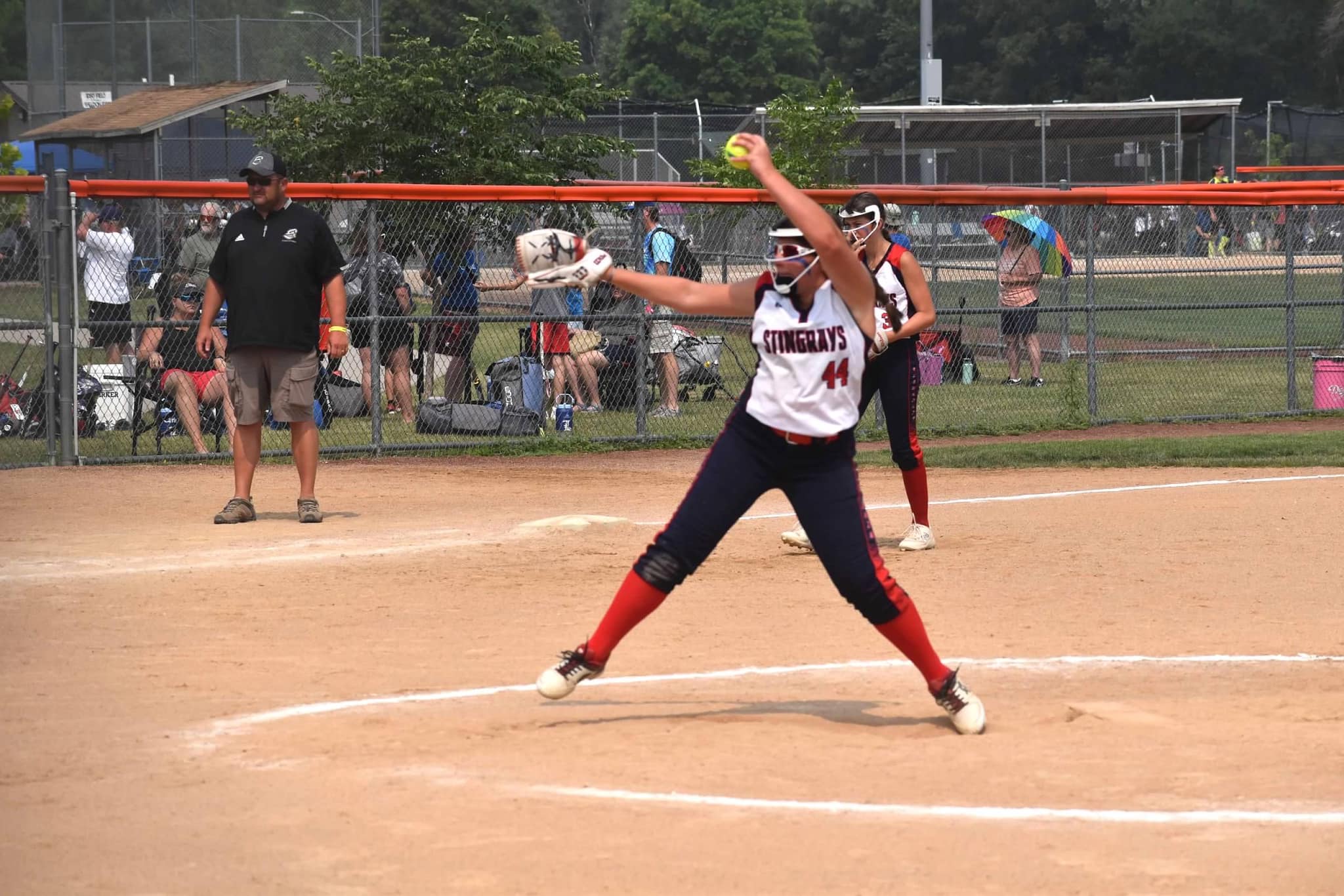
When you go to a game it often seems there are two kinds of people when it comes to the rules of fastpitch softball in general. One group feels like they know absolutely nothing and are often confused about why umpires made the call they made.
The other group is absolutely certain that they know everything there is to know about the rules and that, like the royalty, their word is sacred and indisputable. This post is for both of them.

It was actually spurred by a note from an old coaching friend who told me that after 10 years out of the game he is coming back to coach an 8U team and wanted to be sure he’s up-to-date on the latest pitching rules. Kudos, Ted, on looking before you leap.
We’re not going to get into the entire Rule 6 from the USA Softball rulebook, which covers everything. Instead, we’re going to focus on some of the recent changes as well as misconceptions that even some umpires may have.
Here we go.
Starting position (aka Start Back Rule)
Back in the old days of fastpitch, female pitchers were required to start with both feet in contact with the pitching rubber. That is no longer the case.
Pitchers must start with the foot on the throwing hand side (often referred to as the “pivot foot” or “drive foot”) in contact with the pitching rubber. That doesn’t mean it has to be sitting squarely on it; a heel barely in contact with the rubber is still considered to be in contact both by the rules of softball and the rules of physics.
But the other foot, popularly referred to as the “stride foot,” can be anywhere the pitcher wants as long as it is behind the rubber and within the 24 inch width of the rubber. That said, pitchers need to be careful about how far they set it.
Some will take this ability to the extreme, placing it far back even though it’s not right for them (although that placement can be correct for others). The easy way to figure out a good starting point is to step on the rubber and place your feet like you’re going to steal a base or run a race. Then make any minor adjustments from there.
Step Back Rule
Here’s a quick quiz: once pitchers place their feet and go into their motion are they allowed to take a step further back with the stride foot? The answer is it depends which rules body they are playing under.
A step back IS allowed under National Federation of High School (NFHS), USSSA Softball, Little League, National Softball Association (NSA, but Great Lakes Region only) and often many local rec leagues that are not affiliated with any national organization. If you are playing under a sanctioning body not listed here you may want to check their rulebook to see what is permissible.
A step back IS NOT allowed under USA Softball, PGF, Alliance Fastpitch, and some other organizations (check your local listings). If the pitcher steps back to begin the pitching motion an illegal pitch will be called.
So what does this mean for your pitchers? I teach my students to use a “start back” rather than “step back” technique. “Start back” is legal everywhere, so there are no issues with it.
On the other hand, if your pitcher is used to stepping back and then gets called for it when you play somewhere it’s not allowed, it’s totally going to mess her up for the rest of the game. She will be thinking about not stepping back instead of throwing the pitch, and even if she can block that out it will mess up her rhythm and her timing, resulting in a lot more balls and meatballs than you’re used to seeing.
Have her learn the “start back” and you’ll both be a lot better off.
Leaping (two feet in the air)
This is a fairly recent change. If you’ve been away for a while you remember when fastpitch pitchers were required to drag their pivot away from the rubber; if it came off the ground it was technically an illegal pitch, although this rule violation was rarely called for the most part. At least until you got into an important game and your pitcher was doing it.
This rule was changed a few year ago. Now it’s ok if the pivot leaves the ground and both feet are in the air. I don’t know this for sure but I have little doubt the change was made to eliminate coaches and parents from complaining constantly about an opposing pitcher their players couldn’t hit off of.
It was designed to get rid of all the ticky-tacky chirping when a pitcher’s foot was off the ground by a few inches so the kids can play the game. A good thing by my estimation, as I talked about here.
Of course, you know the story of “give a mouse a cookie.” Rather than simply being grateful that a minor irritation has been removed, some folks have decided to try to take advantage of the new rule by teaching their pitchers to leap like Johnny Lawrence in Cobra Kai.

The problem here is that when you leap that way you’re most likely to land on the foot you pushed from originally, particularly if you plan to maintain front side resistance when you land. If you push again, that’s a crow hop – which is still illegal.
Those who are teaching it claim there is no second push, they’re just landing on it. Either way, now an umpire once again has to watch closely to determine if a rule is being violated – the very thing the original rule was designed to eliminate.
That leaves us with a dilemma. Either the various governing bodies need to crack down on anything they even suspect is a crow hop or they need to eliminate the rule entirely so umpires can focus on the actual game action again. We’ll see what happens going forward.
The hands when taking your position on the rubber
Sometimes in their enthusiasm to throw a pitch young pitchers will develop a habit of stepping on the rubber with their hands together. This is illegal everywhere.
When a pitcher steps on the rubber she needs to have her hands separated. The ball can only be in one hand.
What some umpires don’t seem to understand is that it doesn’t have to be in the throwing hand. It can be in either hand when she steps on the rubber.
Unfortunately if you come across one of those rare folks in blue who don’t know the proper rule there isn’t a whole lot you can do about it. Bringing out the rulebook to prove you’re right is a big no-no.
Basically have your pitcher put the ball in her throwing hand to step on and get through the game. And secretly roll your eyes until next game.
Presenting the ball
I’m not quite sure what “presenting the ball” actually means, but whatever it’s supposed to be let me assure you there is no such rule. Case closed.
Moving the pivot foot prior to the pitch
While some people interpret the rule about keeping the “pivot foot” on the pitching rubber prior to the pitch as meaning it can’t move once it’s in place, that’s not true.
USA Softball rules (which all other rule sets are based on) specifically state the pitcher can slide her foot along the pitching rubber as long as said foot remains in contact with it. That also goes for other little wiggles or motions, including rocking back onto the heel – again, as long as contact is maintained.
What you do have to watch out for is the pitcher lifting her foot off the rubber (even slightly), or stepping forward off it (aka a “gym step”). In the case of the former it’s best to learn not to lift off, but there’s no need to go crazy if it’s coming up a little.
That’s really hard to spot from behind the plate or even from behind first base unless it’s egregious, and even then the umpire has to be inclined to watch for it and call it if he/she sees it. Most of them have more important things to do on the field than watch for that.
Read it, know it, live it
There are plenty of other rules in the rulebook, but these are probably the key ones every coach, parent, and player should know. That said, if you’re a coach playing in leagues or tournaments it behooves you to know ALL the rules, including any specialty rules that are specific to a particular tournament, so you can make sure your pitchers are prepared to succeed.
My good friend Jay Bolden and I have started a new podcast called “From the Coach’s Mouth” where we interview coaches from all areas and levels of fastpitch softball as well as others who may not be fastpitch people but have lots of interesting ideas to contribute.
You can find it here on Spotify, as well as on Apple Podcasts, Pandora, Stitcher, iHeart Radio, or wherever you get your podcasts. If you’re searching, be sure to put the name in quotes, i.e., “From the Coach’s Mouth” so it goes directly to it.
Give it a listen and let us know what you think. And be sure to hit the Like button and subscribe to Life in the Fastpitch Lane for more content like this.
Checkmate! Why Fastpitch Hitting Is Like a Chess Match

Ok, before we begin I am going to flat-out admit I am not much of a chess player. I never liked it as a kid – too slow and boring for me – and can’t remember the last time I played a full game.
Probably when I was in high school, which was a very looooooong time ago.
But I do know enough about it to understand how it’s played from a macro level. Especially after watching The Queen’s Gambit series.
At its core, chess is a game of strategy and anticipation. You don’t go for the kill right away.
You make certain moves in a particular order to put yourself in a position to strike when the chances of success are highest. And you anticipate what your opponent is going to try to do to disrupt that strategy.
In that way it’s a lot like hitting.
The instinct of many young hitters (and more than a few older ones if we’re being honest) is to attack the ball with their bat as soon as it’s pitched. In other words, they initiate the swing with their hands and let the body follow that lead.
That can work sometimes. After all, a broken clock is right twice a day (unless it’s digital, in which case it probably doesn’t work at all) and a blind monkey can find a banana now and then.

It is not, however, an approach that is going to yield regular success, especially in higher levels of play.
Just like in chess, the first move shouldn’t be the main attack. It should be to get the pieces in place so when you do attack the ball you stand a better chance of hitting it.
That’s why a sequence of hips-shoulders-bat after the front foot lands is so important.
The hips have two jobs. The first is to generate power.
The largest and strongest muscles in the body are located in the lumbar-pelvic-hip complex (LPHC). The rotational movement of the hips and core muscles get the body moving in a manner that accelerates as it goes, creating power that can then be transferred up the chain when those same muscles suddenly decelerate the hips.
By delaying the shoulders momentarily, instead of allowing them to ride along with the hips, you create a stretch from the front hip to the back shoulder that acts as a rubber band, helping accelerate the shoulders and ultimately the bat forward rather than using the arms to do it. This frees the arms and hands to focus on directing the bat to the ball rather than yanking it wildly to try to increase the energy.
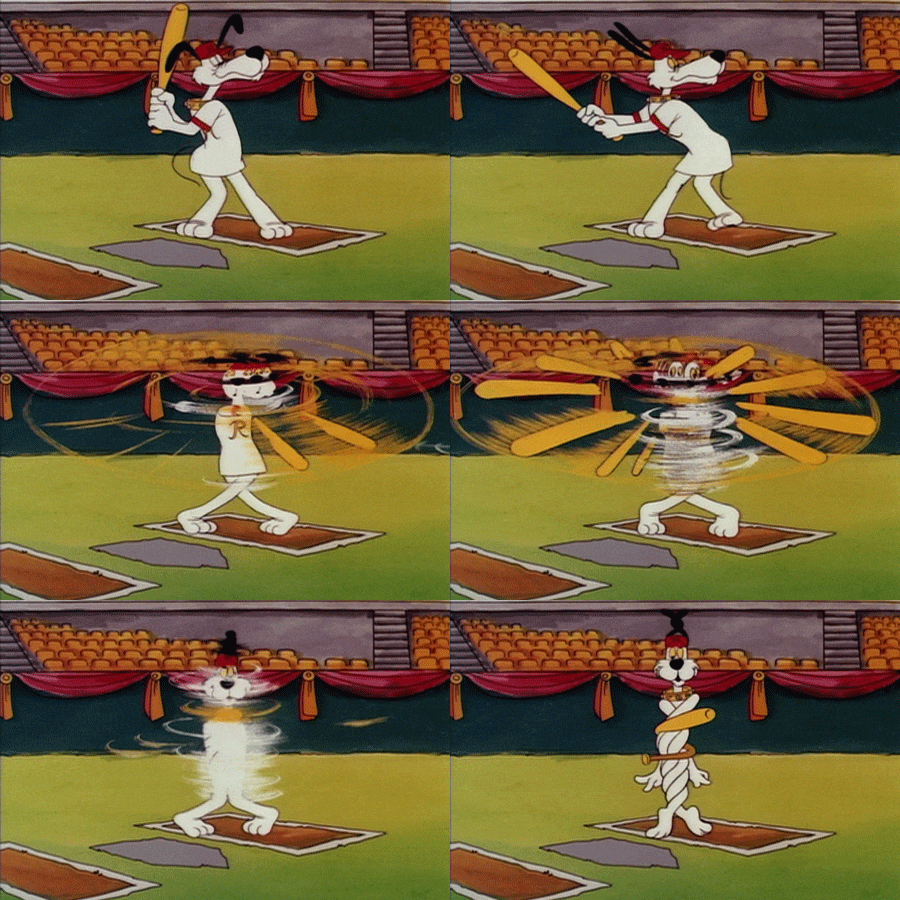
But it’s not just about power. That same movement also helps position the upper body, bringing it to the launch position without having to commit the arms and bat to the ball.
This delay give the hitter more time to see the ball and brings the bat closer to it so the actual launch of the bat occurs over a shorter distance, increasing the chances of making good, hard contact. After all, it’s easier to hit a target from close-in than far away, particularly if it’s not exactly coming in on a straight line.
And that’s where the chess analogy comes in. Rather than rushing the swing, an effective, quality hitter will first get all the pieces in place, then unleash the swing with a controlled explosion when the time is right.
Whereas a weaker hitter will place all her focus on simply getting the bat to the ball from the beginning of the swing.
The other part is the strategic element, the cat-and-mouse game between the hitter and the pitcher. A good pitcher will either be trying to pitch to her strength or the hitter’s perceived or known weaknesses so the hitter must understand what those are and adjust accordingly.
For example, if the pitcher is heavily dependent on her riseball to get hitters out, the hitter must have a strategy to deal with it. That can be to try to stand a little taller and stay on top of it, or look down and lay off those riseballs entirely while hoping the umpire doesn’t have a high strike zone.
The hitter can also look for patterns in the pitch caller’s pitch sequences. For example, if the pitcher is throwing changeups consistently in 0-2 counts, the hitter should be looking for a changeup if she goes 0-2.
In fact, against a tough pitcher she may concede the first two strikes to get to that easier to hit changeup. I’ve seen that work.
Hitters need to be aware of their own weaknesses as well. If a hitter has trouble with outside pitches, and is playing against an opponent who knows that, she should expect a steady diet of outside pitches until she proves she can hit them.
In that case, the strategy might be to crowd the plate and turn the outside pitch into more of a middle pitch – particularly if the hitter is strong on inside pitches. Doing that might even bait the other team into throwing inside to try to handcuff her – at which point she can turn on a pitch she likes and send it off like a rocket.

This is what makes fastpitch softball hitting so interesting and challenging. While it definitely requires a high element of physicality, there are also strategic elements built in that will affect and are affected by the physical components.
No wonder hitting has been called the most difficult feat in all of sports.
So keep that in mind when you’re working with hitters of all ages, levels, and abilities. Have a strategy for how you’re approaching each pitch, and a plan for how you’ll move the pieces in place to execute that strategy, and you’ll greatly increase your hitters’ chances of success.
Checkmate!
My good friend Jay Bolden and I have started a new podcast called “From the Coach’s Mouth” where we interview coaches from all areas and levels of fastpitch softball as well as others who may not be fastpitch people but have lots of interesting ideas to contribute.
You can find it here on Spotify, as well as on Apple Podcasts, Pandora, Stitcher, iHeart Radio, or wherever you get your podcasts. If you’re searching, be sure to put the name in quotes, i.e., “From the Coach’s Mouth” so it goes directly to it.
Give it a listen and let us know what you think. And be sure to hit the Like button and subscribe to Life in the Fastpitch Lane for more content like this.
Chess photo by Gladson Xavier on Pexels.com






 Life in the Fastpitch Lane