Book Recommendation: “Crunch Time”
We’ve all seen it or experienced it: the player or coach who is great in practice (aka a cage warrior) and seems like he/she should be a star, only to struggle when they get into a game. It’s frustrating to watch, especially because the breakdowns often seem to happen at the worst possible time, yet helping them break free of that mindset can be extremely challenging.
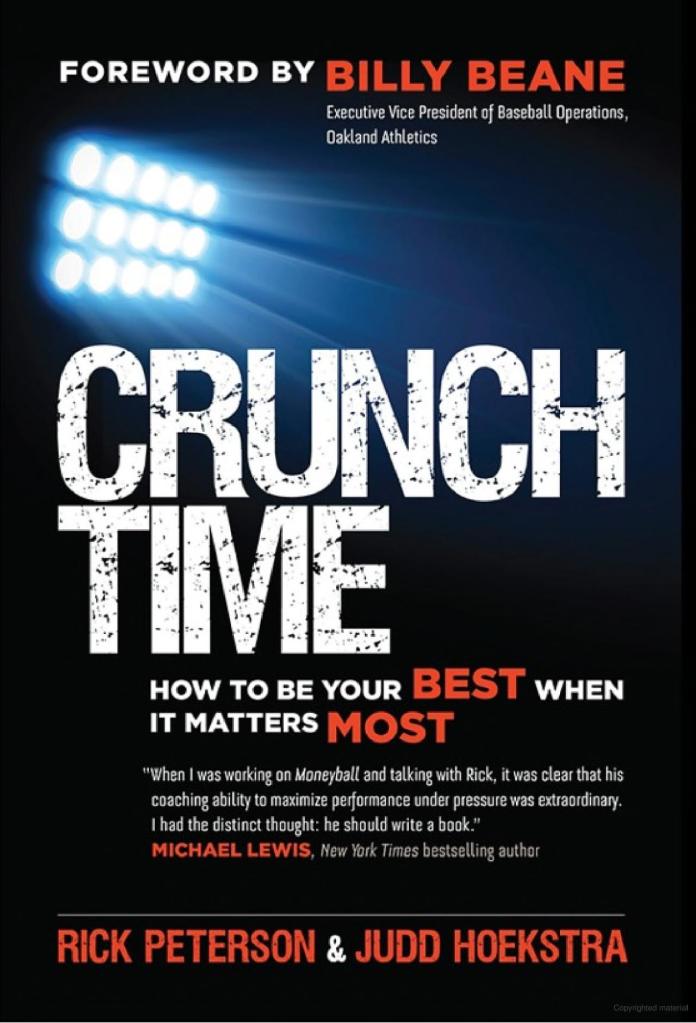
Fortunately I recently read a book that addresses this very issue. It’s called, “Crunch Time – How to Be Your Best When It Matters Most” by Rick Peterson and Judd Hoekstra.
If you’re not familiar with them, Rick Peterson is currently Developer of Pitching Development for the Baltimore Orioles, was the pitching coach for the Oakland A’s during the “Moneyball” era, and is considered one of the top pitching coaches in all of Major League Baseball.
Hoekstra is a bestselling author of books on leadership as well as a vice president at The Ken Blanchard Companies, a consulting firm that specializes in training business leaders at organizations of all sizes. Pretty good pedigrees for both authors.
While the book’s lessons apply to a general audience rather than specifically to baseball or softball, it definitely speaks to the challenges players and coaches face when challenged to perform under extreme pressure. The nice thing is it’s a pretty quick read too; I finished it cover-to-cover while on a 4.5 hour flight coming home from vacation.

The central theme of the book is that when you are facing a difficult situation you need to reframe it in order to manage the stress and allow yourself to perform the way you know you can. In other words, instead of seeing that difficult situation (such as an at bat where the game is on the line) as a threat, view it as an opportunity.
So in that example, the immediate threat is losing the game if the player doesn’t perform well, i.e., get a hit. But the underlying threats are that coaches and teammates will be mad at the player, the player might get benched, teammates won’t want to associate with the player, one or more parents might be angry with the player, the player will be embarrassed, etc.
The result is the player gets so caught up in potential consequences (especially if he/she has faced this situation before and failed) that he/she freezes up and it becomes a self-fulfilling prophecy. It’s difficult to perform at a high level when you’re paralyzed with fear.
After explaining the need for reframing the authors then get into several techniques to accomplish this task in subsequent chapters, including:
- Reframing from trying harder to trying easier
- Reframing from tension to laughter
- Reframing from anxiety to taking control
- Reframing from doubt to confidence
- Reframing from failure to learning moment
- Reframing from prepared to overprepared
Each chapter not only talks about the techniques but offers anecdotes from the authors’ experience of how they were applied. For example, Peterson talks about making mound visits during MLB games where he used humor to help a pitcher put what was happening into perspective, allowing him to get past an initial walk and single in order to strike out the heart of the opposing lineup and get out of the inning.
One of the nice things is that unlike many “mental game” books, applying the lessons in “Crunch Time” doesn’t require going through a plethora of exercises in order to master the techniques. It’s more of a philosophical approach presented in a simple form that makes it easy to grasp the lessons so you can begin applying them right away.
While I’ve been talking about how coaches can use the lessons in “Crunch Time” to help players, they can also use it to help themselves become better coaches at critical points of the game.
In that way it reminds me of a story legendary football coach Bill Walsh told in his book “The Score Takes Care of Itself.” Walsh was one of the first if not the first to develop the laminated play calling sheets all football coaches now have with them throughout the game, and was lauded as an innovator for doing it.
Yet in his telling, the reason he did it wasn’t because of some stroke of genius. It was the result of him having trouble making quick decisions under pressure. By creating the play calling sheets when he was calm and reasoned, i.e., before the game, he could just look at what he figured out already and just follow it, relieving the pressure of those in-game, critical decisions.
The lessons of “Crunch Time” can help in the same way. Take the international tie breaker, probably one of the most high-pressure situations in softball coaching because often any minor miscue or poor decision can lead to the loss of the game and possible elimination from a tournament or conference championship.
Rather than viewing a loss as a threat, by reframing it as an opportunity (we’ve prepared well for this situation so we have an advantage over our opponents who are clearly nervous about it) coaches can make strategic decisions with confidence, knowing their teams will execute, and can convey that sense of confidence to the team to keep them from being rattled and making those types of mistakes.
As I said earlier it’s a pretty quick read but there’s a lot of great thinking contained within the content. If you’re looking for techniques to help your players perform better, and/or ways to help grow your own coaching abilities, I recommend you pick up or download “Crunch Time.”

Posted on November 8, 2024, in Coaching, Mental game and tagged Bill Walsh, Crunch Time, Judd Hoekstra, managing pressure, Moneyball, Oakland A's, raising performance levels, Rick Peterson. Bookmark the permalink. Leave a comment.






 Life in the Fastpitch Lane
Leave a comment
Comments 0