Blog Archives
Why Coaching Different Levels Is Like Teaching in School

The other week I was waiting for my first lesson to come in when my friend and fellow coach Dave Doerhoffer sat down next to me sighing and shaking his head. Dave is an assistant coach at Vernon Hills High School (as well as a private hitting instructor).
As part of that role Dave, along with head coach Jan Pauly, helps oversee instruction for the Stingers travel teams that feed VHHS. On that day his head shaking had to do with the complicated instruction one of the coaches for a 10U team was giving to his players.
I won’t go into details to spare anyone embarrassment, but the gist of it was that while what was being instructed was technically correct for an older player, it was too much for a younger player who just needs the basics to absorb.
This is something that’s probably more common than most coaches and parents realize. Coaches go to a coaching clinic featuring D1 college coaches explaining how they teach this technical aspect (such as footwork at first base) or handle that situation (such as runners on first and third).
Then the travel coaches, all fired up as they ought to be, come back and try to apply those principles to their younglings. Usually with disastrous results. Players get confused, or don’t yet have the skills or experience to apply what’s being taught, and what should be good outcomes become bad ones instead.
Here’s where coaches can learn something from the way school subjects are taught. In language arts, math, science, etc., the early grades start with the very basics, allow their students to learn those, then build on that knowledge when they are ready and able to take the next step.
Take math, for example, Teaches don’t try to teach differential calculus or advanced algebra in first grade. (Thank goodness because I would have never made it out of first grade.)

They start with simple addition and subtraction, then move to multiplication and division. They continue to build on those skills little by little through multiple grades until they can handle more complex and more abstract mathematical principles.
It’s a slow build over time, not just jumping right to the difficult stuff because it’s cool or will make the teacher look good.
The same goes for vocabulary. Young students start with simple words they use and hear every day (except for those words), then learn more complex ones as their basic understanding grows.
Otherwise all that will happen is the teachers will obfuscate the intention in a torrent of enigmatic gibberish until any learning is diffused and the results are ineffectual. So there.
Coaches first need to put themselves into the shoes of their players, evaluate what those players know (if anything) about fastpitch softball, and work from there. Teaching them how to execute a trick play for first and third when those players can barely throw and catch just doesn’t seem like a good use of time or resources.

By the way, this doesn’t just apply to the very young, i.e., 8U, 10U, or 12U players. Ask some college coaches and they will probably tell you stories about good players who lacked basic knowledge on some aspects of the game, such as how to tag up on a fly ball and when you can run. (It’s when the ball is first touched, not when it’s caught.)
When I was coaching teams I learned the hard way not to assume your players know ANYTHING you THINK they ought to know. If you take the stance that if you didn’t teach it directly to them they don’t know it, no matter what they age, you will avoid some ugly surprises just when you need those least.
The bottom line is as a coach you need to look at what your players know and can do, then introduce new concepts that fit within those capabilities. Your players will learn the game better, in a more logical fashion, and you’ll avoid the preventable mistakes that keep us all up at night.
School photo by Ksenia Chernaya on Pexels.com
The Power of a Kind Word (or Two)

A couple of nights ago one of my hitting students, we’ll call her Persephone (for no reason other than it amuses me), came in for her first lesson in a few weeks. She is playing high school ball right now and has been tearing it up for the most part, but Persephone has had a little less success lately and decided it was time for a tune-up.
Her dad walked in before her and gave me a heads-up that Persephone had had a rough game that night, going 0-3, and was also having a little family-based teen angst on top of it. Always nice to have some warning in those cases.
When Persephone came in (wish I’d picked a name that is easier to type) I could see her mental state was no minor issue. She was an emotional pot ready to boil over.
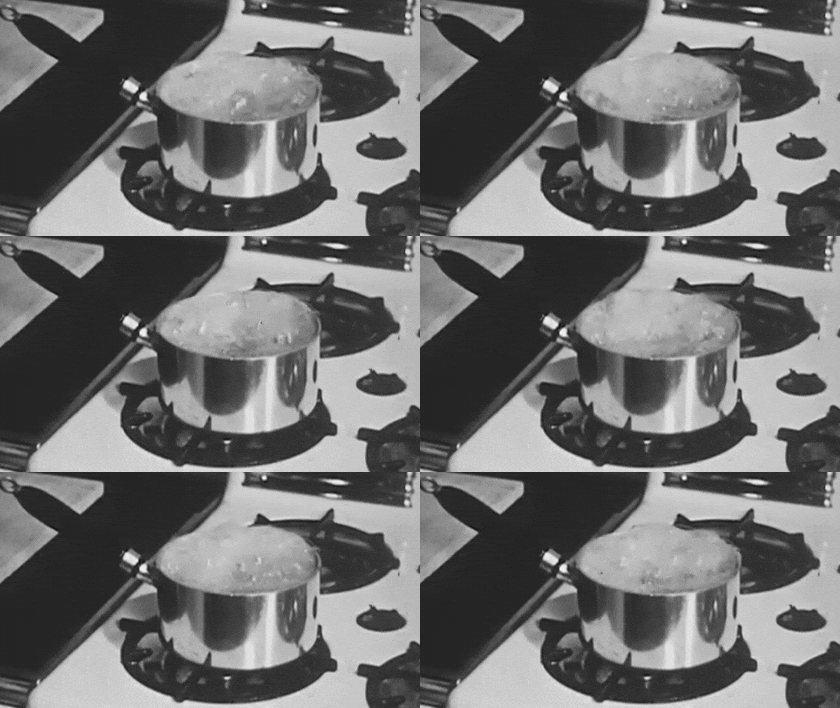
She was trying to keep the lid on it, but it was rattling pretty hard. Most of the time she is a pretty even-keel, laid back young woman but even the toughest among us can get overwhelmed at times, and that’s what was happening here.
We started into the lesson and I asked her about the game. She told me she just couldn’t hit the pitcher, and in particular was unable to touch her curveball. Persephone told me she was swinging and missing it by quite a bit.
Her dad had told me in the beginning that it wasn’t just Persephone who had that trouble that night; the opposing pitcher was one walk shy of a perfect game. But Persephone is a team leader who sets high standards for her performance, so it didn’t matter to her that everyone else struggled; she felt she could have and should have hit that girl anyway.
I talked to her some about the mental game, staying focused on the process instead of outcomes, keeping it simple, how to relieve stress at the plate, all of that. It helped somewhat.
When I went to front toss I identified a mechanical flaw too – she was pulling her front side out instead of hitting around it, so it’s no wonder she couldn’t touch those outside curveballs. She made the correction and started hitting a little better, but I could see she was still in her own head too much.
Then the miracle happened.
There was another hitting instructor doing a lesson in the cage next to us. His name is Dave Doerhoefer, and we have known each other for more years than either of us probably cares to admit.
Dave is a friend as well as a great coach, and we often have chats about the current state of the sport, especially when it comes to teams playing too many games and not practicing and teaching enough.
He was working with his student on firming up her front side as she went into rotation instead of letting it collapse but she was having trouble grasping the concept. His line of sight took him directly toward our cage and he saw how hard Persephone was swinging the bat and how sweet her technique was, so he asked Persephone if his student could watch her a few times because she has such a nice swing.
It was literally like the clouds had parted and the sun was doing a happy dance in her heart.

Dave’s question totally pulled Persephone out of her self-inflicted funk and her face just lit up. Then she started lighting up my front toss pitches too – including the outside ones.
That one simple question, which was also in effect a great, unsolicited compliment from someone that had no stake in the process but just liked what she was doing, turned Persephone’s entire approach around.
Later I thanked Dave for his kind words and told him what it had meant to Persephone. He shrugged and thanked me for telling him that, but admitted he had no motivation in it other than wanting his student to see another hitter doing what he wanted her to do in real time.
Now, I will say Dave may come to regret his kindness because in addition to being a hitting instructor he is also a varsity softball coach at Vernon Hills High School, and his team may play Persephone’s somewhere along the way – perhaps the State playoffs. But I’m sure he’s ok with it because Dave’s #1 focus is on helping fastpitch softball players get better, no matter if they are his or his opponents’.
The point here is it didn’t take much to make Persephone’s day and help her go from feeling bad about herself when she came in to walking on air with a big smile on her face when she left. You have the power to do the same.
When you’re at the field and you see someone do something great, whether it’s a driving big hit or making a diving catch or throwing a knee-buckling changeup or making a heads-up slide, don’t just admire it to yourself. Find that girl after the game and tell her – even if she’s on the opposing team. That goes for parents as well as coaches.
You never know what someone else has been going through, and those few kind words may be just the inspiration they need to keep fighting and overcome their struggles. It only takes a few seconds, but the ripple effect from that encounter might just alter the trajectory of a life in a positive way, even if just by a few degrees.
And the best part? Offering up a sincere compliment now and then doesn’t cost you anything but a little thought and time.
I know some of the happiest stories my students tell me are when an opposing coach or parents tells them they did a great job. So this weekend, get out there and if you see something good say something good about it.
You never know who needs to hear it.
My good friend Jay Bolden and I have started a new podcast called “From the Coach’s Mouth” where we interview coaches from all areas and levels of fastpitch softball as well as others who may not be fastpitch people but have lots of interesting ideas to contribute.
You can find it here on Spotify, as well as on Apple Podcasts, Pandora, Stitcher, iHeart Radio, or wherever you get your podcasts. If you’re searching, be sure to put the name in quotes, i.e., “From the Coach’s Mouth” so it goes directly to it.
Give it a listen and let us know what you think. And be sure to hit the Like button and subscribe to Life in the Fastpitch Lane for more content like this.
Lead photo by Pixabay on Pexels.com
Congratulations to Jan Pauly, new VHHS varsity softball coach
Today’s post will be fairly meaningless to many of you, but I wanted to share some good news with the rest. My friend and fellow IOMT Castaways coach told us this week that she has been named the new varsity head coach at Vernon Hills High School.
I’ve known Jan for several years, starting from when I coached her daughter Erin, and I can tell you Vernon Hills has found themselves a winner in several ways. First, Jan is very knowledgeable about the game. She played through high school and college, and coached travel ball for several years. the good thing about her is that she doesn’t just rely on the way things used to be, but also keeps up with the current thinking on the game.
More importantly, though, she genuinely cares about the players in her charge. Not just as softball players but as people. She’s a huge believer in team over individual glory, although if an individual has a problem or concern, softball or otherwise, they can bring it to her.
Of course, no discussion of Coach Jan would be complete without talking about how intense she is during games. She can look like she’s pretty angry at times, especially if things aren’t going right. But she’s not angry, actually. She’s just focused. Once players understand that I’m sure they’ll enjoy playing for her – and learning from her.
I’m personally looking forward to seeing what she does with team. So congratulations, Jan! I know you’ll be great.






 Life in the Fastpitch Lane