Category Archives: General Thoughts
It’s not about getting knocked down; it’s about getting up again
Saw the “mini-essay” below in the Liberty Mutual “Candrea on Coaching” email from ASA and Liberty Mutual and thought it was worth passing along. According to the email the author is anonymous. But it really speaks to the attitude you need to bring both to fastpitch softball and to life in general. In fact, the two are so closely tied that it’s one of the beauties of our sport.
Like softball, life can knock you down, and when it does you’re likely to feel bad. But what separates the winners from the losers isn’t that the winners don’t get knocked down. It’s that they get up again. Here’s the essay. I also liked the kite quote at the end.
Get Up
It has been said that your success is insured when you’re willing to get up at least one more time than you get knocked down. Hey, we all get knocked around. Like it or not, it’s just a part
of everyday life. No one, not the most or least talented among us, are exempt from the trials and tribulations of day to day living. But it’s how we respond to these temporary setbacks that will
in large measure determine how far we go and how high we fly in life.
When life deals you a crushing blow, you must condition yourself to quickly pick yourself up off the canvas and get back into the game. Winners always do. They realize that it’s OK to get
knocked down and that it’s perfectly normal to feel saddened hurt or disappointed about being knocked down. Lets face it, nobody likes to lose or encounter difficulty. But the winners also
recognize that the getting up part is ninety percent of overcoming any adversity placed in their paths.
Don’t worry about getting knocked down. Since it’s going to happen regardless of whether we like it or not, especially when we’re passionately and enthusiastically chasing your dreams, we should vow to keep getting up each and every time. Laying there, moping and feeling sorry for themselves, isn’t going to get them to the winners circle.
Never lose sight of the fact that you were placed here for a reason. There is a song in you that desperately needs to be sung. There are just too many good times, good things and great people out there to enjoy to ever allow a temporary setback to hold you down or hold you back. When you vow to get up every time you get knocked down, you’re well on your way to living the life others only dream about.
“Do not fear the winds of adversity. Remember: A kite rises against the wind rather than with it.”
How to know you’re getting through
In my last article for Softball Magazine, I used one of my favorite little teaching devices to talk about the importance of commitment to what you’re doing. The article focused on what is the difference between bacon and eggs. The answer, of course, is that the chicken is involved, but the pig is committed. I finished, as I do in lessons or team practices, by telling readers they should be the pig. 
I do know that message got through to at least one of my students. I usually get a box of extra Softball Magazines when they come out, so I will distribute them to my students. This one was no exception. Each of my students received a copy of the magazine, including a girl named Erin who is new with me this year.
Well, lo and behold, right before Christmas she comes to her lesson toting a good-sized red shopping bag, and inside the bag is the piggy bank shown in the picture. She had customized it with the saying “Be A Pig.”
Obviously the article made an impression on her and her family. Hopefully she’s living it too! But this was so cute I just had to share. I love it when a plan comes together!
So, what did Softball Santa put under your tree?
Now that we’re a few days past Christmas/Channukah/Kwanzaa/Winter Solstice, I’m wondering what Softball Santa brought you. Would love to get a little dialog going on this topic. I’ll start.
I received a dozen Jugs Lite Flite balls and a dozen TCB balls . The Lite Flites are actually for vision training, not hitting. I will be marking them with the numbers 1-4 in black and red Sharpie and adding them to the ones I already have. That way the girls won’t be able to cheat by remembering which balls have already gone by and guessing by process of elimination.
The way we’ll use them is to shoot them through a Jugs pitching machine and have the girls try to identify the color and the number on the ball as it whizzes by. Sounds impossible, but actually it’s not.With a bit of practice and effort you can actually see the number as well as the color. It’s a nice, cheap imitation of the expensive Vision Trak training that uses tennis balls and a specially designed machine.
The TCB balls are for hitting, obviously. I’ve heard a lot of good things about them. If you hit them square they fly well. If you’re off a bit, they deform momentarily and you know you need to improve your bat path. I’m anxious to try them out at the next practice.
The other thing I received is a copy of the book The Talent Code . It’s about how top performers are made, not born with innate ability — and how you can create them too. Watch this space for a more detailed review.
So that’s me. What did you get? And what are you still looking to get?
Difference between coaching boys and girls – part two
We’ll skip the intro here. If you want that explanation, see this post . Let’s get right to it.
Yesterday I was using a blackboard to create a list of factors that can affect a play. I didn’t have chalk at first so I’d written the list on a piece of paper as the team called out different answers. Then when the chalk got there (thank you Pat Foley for finding it) I tried to quickly transfer the answers to the board.
As you might expect, most of the handwriting was pretty sloppy and hasty. But then, I continued to write, one of the girls said, “Look at that. It’s a perfect U.” I looked up and sure enough it was. Several of them commented on the high quality of the U, a brief discussion ensued, and all I could do was smile and shake my head.
Only girls would notice something like that.
Incidentally, they also could not get over how much my hastily scribbled “g”s looked like “s”s. Oh well. At least they liked the U.
Difference between coaching girls and boys
As pretty much any experienced fastpitch softball coach will tell you, there is a definite difference between coaching girls and boys. In fact, I’d bet anyone who has done both will agree with that.
Last night I saw another amusing example of one of those differences. I was in the middle of a lesson with a pitcher when I looked up and saw one of my hitting students (Kaylee) getting ready for her lesson, which would start in about 10 minutes.
She put up her hair, which is to be expected. But then she pulled out a small mirror to check it before putting on her helmet. That is definitely a girl thing.
I couldn’t help but smile to myself. I mentioned it to her when the lesson started. She just smiled and shrugged her shoulders.
With boys you’re lucky if they’ve showered in the last couple of days. But girls have a whole different mindset.
So what’s your favorite “coaching girls” story?
Good service project/team building activity
Just got back from a very cool service project that doubled as a team building event. It was with an organization called Feed My Starving Children. Essentially, you pack dried food into bags, seal them, then pack the bags into a box that could be shipped to hungry children pretty much anywhere in the world.
I was looking for a service project for our players, a way for them to give back to the community (or in this case the world). One of our parents suggested it, as she has participated before. This one was extra meaningful because it was to benefit kids like them. It’s amazing that one of those packets, which is a little larger than a packet of brown sugar, can feed six children or four adults for a day. 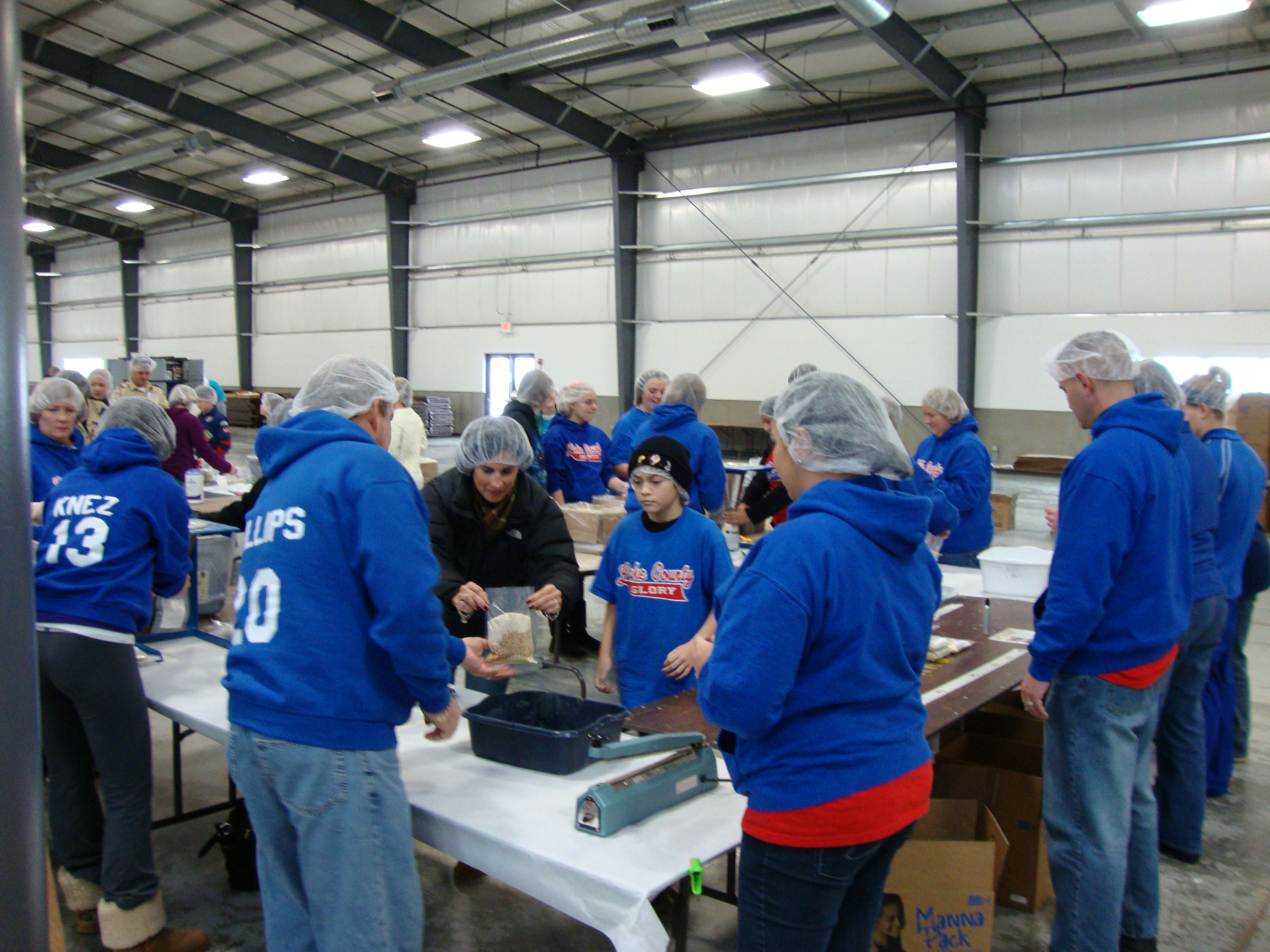
The other nice thing about this project is its team building effects, both for the players and any parents who participate. It’s essentially a mini production line, so everyone has to work together to keep things flowing. Once you get into a rhythm it’s amazing how quickly you can get things going. Our girls were having a good time, talking and working together. So were the parents, friends and sibilings who also participated.
The shift we participated in packed 257 boxes, which accounted for 55,512 daily meals — enough to feed 152 children for an entire year. That’s a pretty good feeling.
If you’re looking for something non-softball for your team to do in order to understand how fortunate they are, and to help them grow into good citizens as well as good softball players, I highly recommend this one. Several of our parents walked out at the end of our two-hour shift saying they plan to do it with their neighborhood, church or some other group. Looks like it will be an annual event for us! 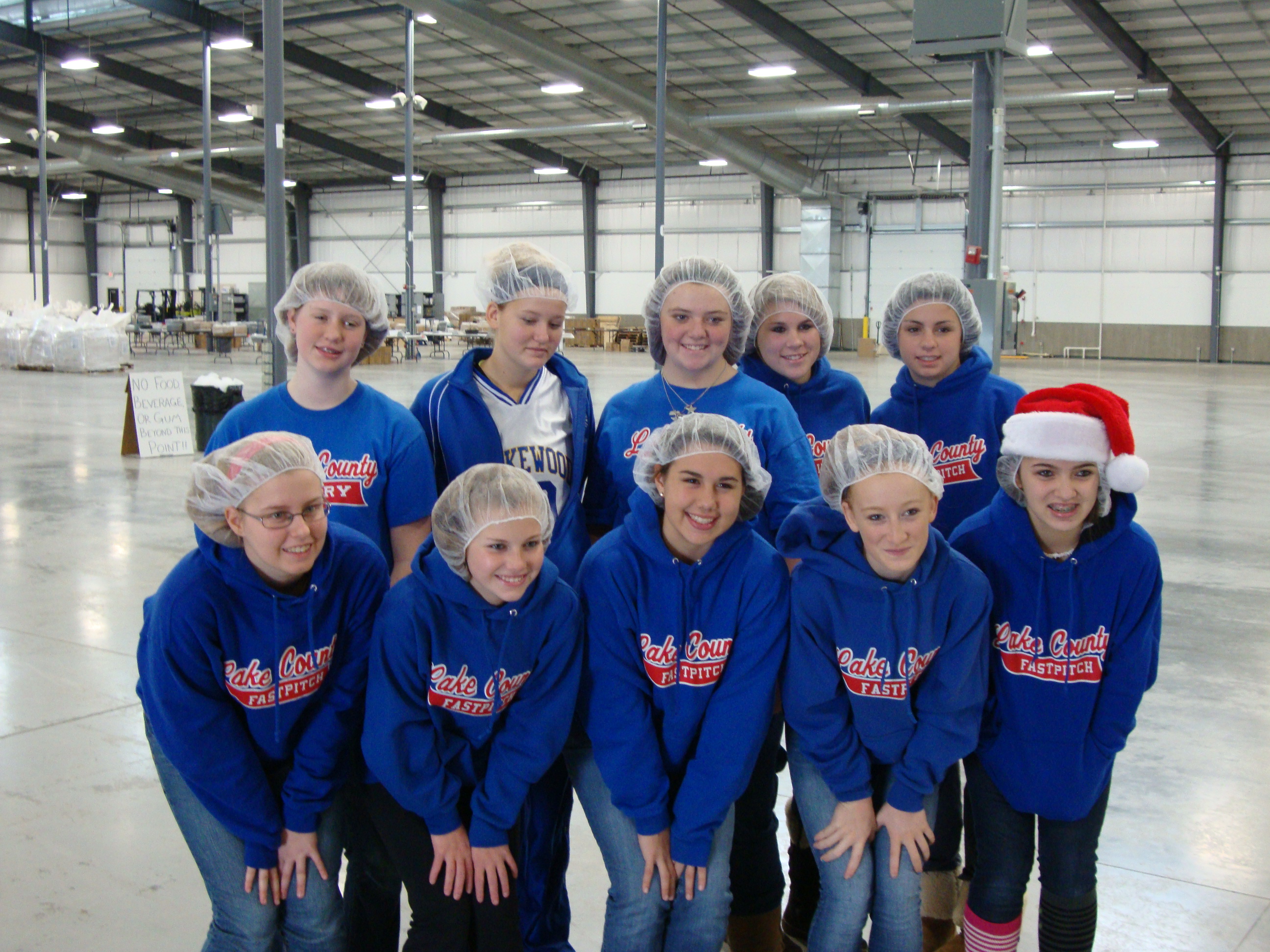
Congrats to our sister team, Lake County Freedom
Over the last weekend, our sister team, the Lake County Freedom, took first place in an ASA Northern Nationals qualifier tournament, so I wanted to give them a shout out and hearty congratulations! Here a link to an article from the Chicago Tribune that covers it in more detail.
I’m also proud to say that our Lake County Glory did its part to help, loaing the Freedom one of our players (Justine Schattner) who did just fine despite playing against girls three to four years older in some cases.
So congrats, Freedom! Keep up the good work.
Observation – more moms are getting involved these days
There is a phenomenon I’ve been noticing lately. Not sure whether it’s good, bad or indifferent, of if it even really matters. But it is interesting nonetheless.
If I recall correctly, when I first started coaching I primarily dealt with fathers. They were the ones who would contact me looking for a team for their daughters, or to set up lessons/extra help, or to ask questions. Sure, there was the occasional mom who would get involved, but they were the exceptions. It was like sports equalled dad.
These days it seems to have gone the other way. The parents who contact me most often now are moms. Sure, I still have contact with the occasional dad, but for the most part if there’s a parent with a question, or who wants to set up a lesson, it’s a mom. In some cases, the moms played themselves so it makes sense. But even if they didn’t, they’re the ones who seem to be more involved in their daughters’ athletic careers.
Is it just me, or are you noticing this trend too? If you’re a coach, are you talking/emailing more to moms than dads these days? If you’re a parent, is it the mom or dad who’s most involved in your daughter’s athletic career — fastpitch or otherwise?
Take concussions and head injuries seriously
Received this article today from my friend Angela. Those of you on the Discuss Fastpitch Forum know her as Angstoner. The article is from the New York Times, and it discusses how seriously the NFL is taking concussions and head injuries in general.
The reason I pass it along is that there are lessons in here for fastpitch softball coaches as well. The NFL has never been known for its abiding concern for its players. They are more of the “patch ’em up and get ’em back in there” school. There are lots of stories about players secretly receiving cortizone shots on the sidelines so they could return to an important game. So if the NFL is taking head injuries this seriously, the rest of us should too.
The problem with head injuries in general, and concussions in particular, are they are often difficult to diagnose. Here’s a little more information on concussions in case you want to learn more. Essentially, though, it’s not like a cut or a broken bone where the evidence is visible. There’s some judgment involved, and some questioning of the player unless the symptoms are severe.
Chicago Bears linebacker Hunter Hillenmeyer was put on injured reserve for the rest of the year due to a concussion he suffered in the third preseason game. He sat out game four I believe, then played a half in the first regular season game. Although he didn’t suffer a blow to the head in that game he started complaining of dizziness and being sick to his stomach. It was traced back to the concussion, and now his season is over.
That’s what’s tricky. A player may seem ok, and may tell you she’s ok when she’s really not. She herself may not realize how serious the injury is.
I experienced that this past summer. Our team was playing at the ASA Northern Nationals. We were playing for our lives and locked in a tight 1-1 contest. In the bottom of the fifth, with two outs, a ground ball was hit to short. Our shortstop went to field it, and the runner on second ran into her head-first. One of our other players saw her helmet contact our shortstop’s facemask. Our shortstop went to the ground immediately, and was down for about 5-10 minutes while we tended to her. She was in tears, too, which was unlike her. She finally was able to stand and we got her off the field.
When our half of the inning finished I had to make a decision. The shortstop said she was fine and could play, but I chose to keep her out. Just did not want to mess with a head injury. I don’t know if it made a difference, but the other team scored a few and we were eliminated. Still, I felt then and feel now it was the right thing to do. Especially after I checked with her mom a few days later and she said the girl was still a bit fuzzy at times.
It’s tough to make that decision, especially in a close game. You know any change might upset the apple cart. Better that, though, than risk a kid’s health over a stupid game. If the NFL is taking it seriously, the rest of us ought to as well.
16U players looking for a home for 2011
Hi everyone. I don’t usually do this, but I happen to know of five 16U players who are looking for a team and wanted to put the word out any way I can. All played for me last year as 14U players, and I would take them again in a heartbeat if they didn’t age up to 16U.
In any case, if any 16U teams in the Northern or Northwest suburbs of Chicago, or even in southern Wisconsin, are looking for quality players with great attitudes, please let me know. You can email me at coachken@softballsuccess.com or use the Web call button on this site to call me.
By position, there are a right and left-handed pitcher/OF/1B, two 1B/OF and a catcher. All of these girls can hit, so you’d be helping out your team in more than one way. Thanks.






