Author Archives: Ken Krause
Good service project/team building activity
Just got back from a very cool service project that doubled as a team building event. It was with an organization called Feed My Starving Children. Essentially, you pack dried food into bags, seal them, then pack the bags into a box that could be shipped to hungry children pretty much anywhere in the world.
I was looking for a service project for our players, a way for them to give back to the community (or in this case the world). One of our parents suggested it, as she has participated before. This one was extra meaningful because it was to benefit kids like them. It’s amazing that one of those packets, which is a little larger than a packet of brown sugar, can feed six children or four adults for a day. 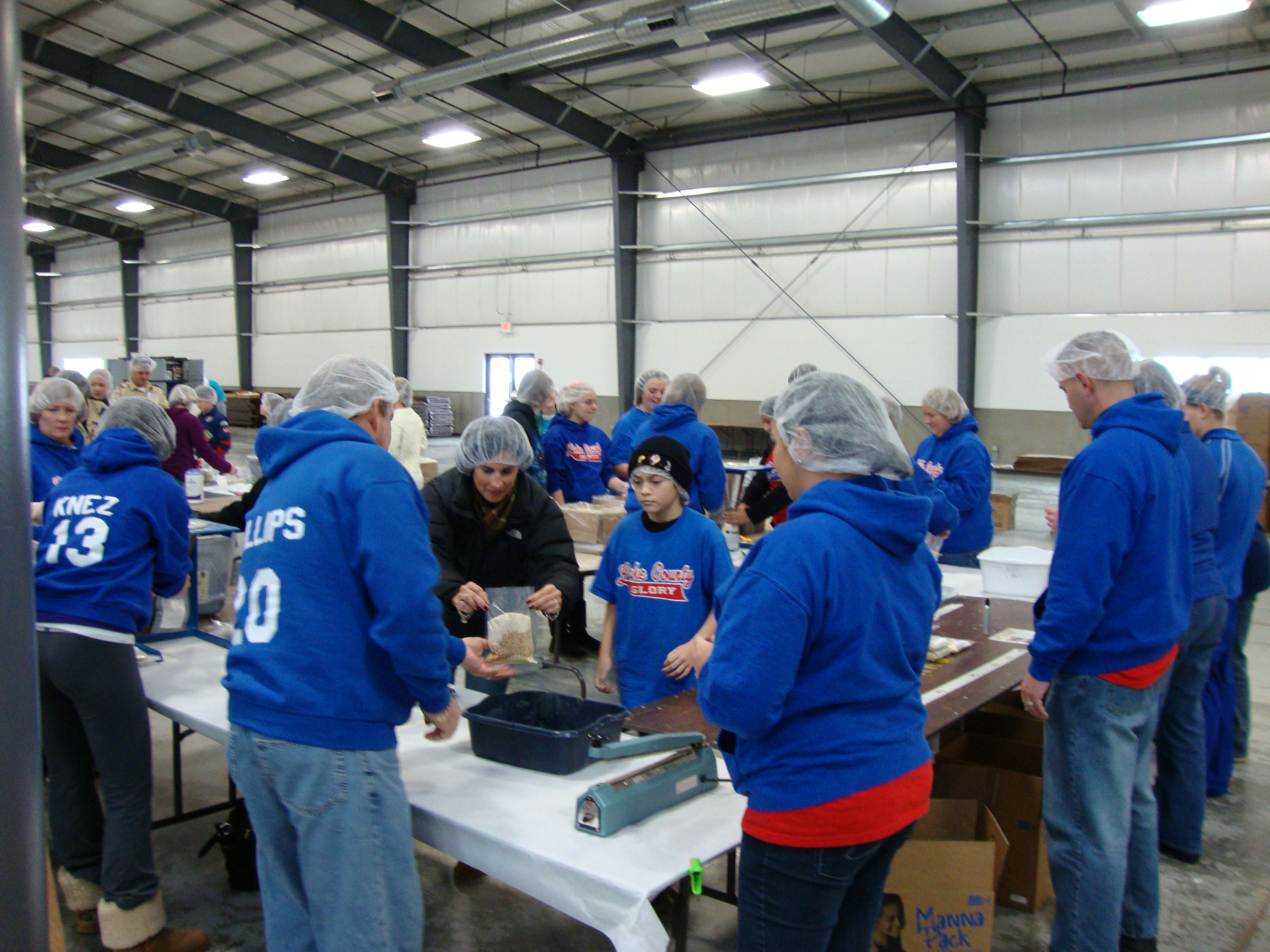
The other nice thing about this project is its team building effects, both for the players and any parents who participate. It’s essentially a mini production line, so everyone has to work together to keep things flowing. Once you get into a rhythm it’s amazing how quickly you can get things going. Our girls were having a good time, talking and working together. So were the parents, friends and sibilings who also participated.
The shift we participated in packed 257 boxes, which accounted for 55,512 daily meals — enough to feed 152 children for an entire year. That’s a pretty good feeling.
If you’re looking for something non-softball for your team to do in order to understand how fortunate they are, and to help them grow into good citizens as well as good softball players, I highly recommend this one. Several of our parents walked out at the end of our two-hour shift saying they plan to do it with their neighborhood, church or some other group. Looks like it will be an annual event for us! 
Helping slappers learn to stay in on the plate
Converting a right-handed hitter into a lefty slapper has any number of challenges — not the least of which is it’s awkward as all get-out. To get some small measure of just how tough it is to make that move, take one day and do everything with your opposite hand — eat, write, deal cards, whatever.
Now picture that in addition to those things you’re doing them while moving, and while whatever it is you’re trying to do is moving too. Hey, hitting is tough enough. But doing it opposite-handed while running toward the pitcher? That’s just nuts.
Yet it can be worth all the effort, because a girl who can put the ball in play and get up the line fast enough to put pressure on the defense is highly valuable. After all, as Coach Candrea says, speed never has a slump.
So yes, there are lots of good reasons to do it. But it takes a lot more than just moving the hitter across the plate and saying “watch how Natasha Watley does it.”
One of the toughest parts is learning to keep the shoulders closed toward the plate so the hitter can drive the ball toward the left side of the infield. That’s important, of course, to make the throw take longer and give the hitter the best chance of getting on base. But after taking the crossover step, especially for a righty that is being converted over, it’s very natural to turn the shoulders along with the hips as shown in the first video. When that happens, the hitter is far more likely to pull the ball to the right or hit it back at the pitcher than to drive it to the left.
You can tell her to keep her shoulders in, but that’s easier said than done. So here’s a more specific instruction. Tell her that as her left foot crosses over her right, she should pull her left shoulder back. When that occurs (as seen in the second video clip) the shoulders stay closed and she’s in a good position to slap.
It’s simple, but it works!
Least favorite softball hitting drills – Part one
There are a lot of great drills out there to help fastpitch softball hitters learn to hit more effectively. Then there are some that seem to have no purpose at all. They might appear to be a good idea, but in truth they work counter to what you’re probably trying to accomplish. Today I’m going to talk about one of them. Don’t bother looking for part two right away — it’ll happen when it happens.
Anyway, the drill is one I used to use. There are plenty of names for it, but I’m going to refer to it as rapid fire. Essentially, a coach gets down into soft toss position, and then starts tossing balls at the hitter in rapid succession. As soon as one ball is hit the next ball is tossed. Keep doing that for 10 or 15 tosses.
Theoretically, the drill is used to teach hitter to have a quick bat. Yet it’s completely useless for that, because the swing you end up taking has nothing to do with your game swing. All you really wind up doing is swatting madly at the ball in order to keep up. In fact, in my opinion this drill probably does more harm than good because it works against the principles of good hitting.
What is one of the keys to good hitting? It’s timing — recognizing the pitch speed and creating a controlled explosion into the ball. When you’re doing rapid fire soft toss you have no opportunity for timing whatsoever. There’s no load, no stride/weight shift, no connection, no rotation into the ball, no extentions after contact, nothing. You just use your hands and arms. Is it any wonder that players who are forced to do this drill repeatedly end up with wimpy arm swings? If your goal is to get your players to pop up and ground out, this is the drill for you!
Another thing it does is destroy any semblance of a good bat path to the ball. The hands go wherever they have to in order to make contact. Most of the time that’s somewhere other than where the hands should be when swinging. And the worse the coach is at tossing, the worse the bat path will be.
But what about batspeed? Doesn’t it at least help with that? Not really. Batspeed is the culmination of a number of things in the swing. Personally, I think the hands and wrists are one of the least important contributors. So a drill that isolates them isn’t going to do much. Except maybe encourage an early wrist roll.
Bottom line is any drill that sacrifices good hitting mechanics, and the core principles of hitting, for some isolated (and perceived) gain is a bad drill. If you’re using it, drop it from your practice plan. Now. Before you do the kind of damage hitting coaches have to spend weeks to undo.
If you want to develop batspeed, have your hitters learn to use their bodies more effectively. Make sure you understand the kinetic chain of hitting so each body part is firing in order, at the right time. Speed up the pitching machine or have your hitters stand closer while you front toss. Anything but fire ball after ball at them.
As I said, I used to use this drill too. Then I learned better. You can do the same.
Product review: Jennie Finch Softball Powerline Pitching Mat
When you live North of the Mason-Dixon line, you tend to spend a good part of your fastpitch softball off-season training time indoors. While that certainly beats freezing your butt off in sub-zero temperatures, it also presents some interesting challenges — especially for pitchers.
For several years I have used a couple of different pitching mats rather than having students pitch off the floor. The mats have built-in pitching rubbers, which is good, and the one from Club K also had the powerline built into it. (The other one, a turf-type, did not, but I solved that with some line marking paint.) The trouble, though, was that they tended to slide on the turf surfaces used in batting cage facilities due to their rubber backing. I constantly had to adjust the mats to keep them lined up with the plate. I’m sure they work fine on a wood gym floor, but how many of us have access to those?
It’s not a problem anymore, though. I recently purchase two of the Jennie Finch Softball Powerline Pitching Mats with foam backs, and I have to say they’ve been acting as-advertised. The web listing claimed that the foam back would stick like Velcro to a turf surface, and by golly that’s exactly what has happened. After a week’s worth of using them in two different locations I can safely say that they have not moved an inch, even when used by some strong pitchers.
That alone made them worth the price ($215 plus $30 for shipping). But they are also good mats in other ways.
The turf surface itself is high-quality, and appears as though it will be very durable even under regular use. The bright green turf is split by a bright white powerline that makes it easy for students to see and keep themselves going straight. The mat is also thick, providing a little cushioning when landing versus the usual thin turf over concrete floors. My students have definitely appreciated that.
The transaction with On Deck Sports was smooth, and the mats were delivered within a few days. Incidentally, they come with a vinyl carrier that makes them easy to cart to and from a facility. The carrier was tucked into the center of the rolled-up mat, so you’ll want to grab it before you bring it somewhere.
Time will tell as far as durability goes. But if you’ve been struggling with keeping a pitching mat in place, I can definitely recommend this one. Just be sure you specify the foam backing.
One final word. If you watch the video demo, you’ll see Jennie Finch is illegal on every pitch she throws from it. That’s unfortunate, and I wish someone would notice and correct that. But don’t let that discourage you. It’s still a good product.
Day Three at the NFCA Coaches College
Ok, technically this is the day after Day Three. By the time I got home, a six hour drive after the class finished, I was too exhausted to do my final report. And since I knew I was taking Monday off from work anyway I figured I could let it go a day.
The final day was a relatively short (and relaxed) session, from 8:00 AM to Noon, which included getting our certificates of completion. We had covered a lot of ground in the last couple of days, so this day was really focused on pre-game, post-game, during-game situations and things like that. The instructors also answered a lot of questions from the students.
Of course, one of the cool things about this program is that it isn’t designed to be a strictly one-way lecture. There was a lot of the instructors asking us what we think, or what we would do (or have done) in such situations.
One thing I noticed is how reluctant a lot of these good coaches were to speak up, at least early on. I kind of felt bad because I was answering a lot of the questions throughout the weekend. But I also felt bad for the instructors, because I know the feeling. I think we all do. You ask your team a question, such as “What do you do when you are on first, there’s a runner on second, there is one out, and the hitter pops it up?” and all you get are blank stares. So when the silence got uncomfortable I’d chime in so the instructors weren’t left hanging. By the last day, though, more people started providing answers, which was good.
The funny thing is, there are answers, but not necessarily the RIGHT answer. Even when we looked at situations from the Womens College World Series it was tough. They’d have a still photo from the TV broadcast on-screen, say here’s the situation, what would you do? Then we’d break into groups of four or so to come up with answers.
Trouble was, there was still a lot we didn’t know. One I recall is it’s late in the game (fifth inning I believe), you’re the home team and you’re down two runs. You have runners on first and second with two outs after a hit. Do you use a pinch runner, and if so for whom?
Our group was thinking put in a rabbit for the runner on first, because she might be able to score on a ball in the gap. You figure the runner on second will already score, and she’s only one run, so it’s the trail runner who’s key. But what we didn’t know was A) do we have any real rabbits on the bench,  can the next hitter (or a pinch hitter put a ball in the gap), C) how fast is the outfield (and how strong are their arms), etc. But hey, that’s just like a real game isn’t it?
The other cool thing in all of this is the relationship the students develop with the instructors. Carrie Dever-Boaz made a point of saying that every time she does one of these classes she’s writing down notes and learning as she goes. John Tschida and Jay Miller agreed. There is just so much to learn in our game, so many great ideas and ways to teach it, that you can’t possibly know it all. That’s what keeps it challenging.
I know I had fun. I always enjoy going to these classes, and always come out with new ideas, drills, approaches and the like. I also enjoy meeting coaches from all over and hearing about their challenges and triumphs.
But since I know some of my fellow students also are Life in the Fastpitch Lane readers and Discuss Fastpitch members, what did you-all think? What were your favorite parts of the classes? What was your experience like? If this was your first time, would you do it again?
As for me, it’s off to take my follow-on test. Wish me luck!
Day two at the NFCA Coaches College
Just got back from the NFCA Coaches College. Today was the long day. We started at 8:00 AM and finished up a little after 5:00. That’s a lot of softball talk, but it seemed to go by pretty quickly. Helps to have instructors who are polished presenters!
First off, one thing I forgot to mention yesterday is that I’ve run into a few Discuss Fastpitch Forum members. That was cool. So many of us go on there and “talk” anonymously with one another. It was nice to put faces with names, and to hear people find it valuable. If anyone else is there, stop by and say hello. I’m “Babe Ruth.” Attendees will know what that means. 
For the last hour of the class today we got to watch each of the instructors run a mini practice. It’s fun to watch someone else do it, see how they approach things and how they relate to the players – all of whom are either middle school or high school age. Got a couple of good drills, a couple of variations on some old ones, and some neat vision training ideas.
At the end they had all us coaches do a little pitching with wiffle balls and a little fungo hitting. I can safely say I nailed the pitching part, which should be no surprise. In addition to teaching pitching I usually pitch BP before games — with wiffle balls. So the drills there were pretty easy.
Fungo hitting was another story. We were supposed to hit fungos and knock balls off of tees. I was horrible! I think we each got three shots. The first one I pulled and almost hit Carrie Dever-Boaz and a young lady named Morgan who was helping out. The second one I whiffed entirely. I finally got a decent ground ball my third try. Of course it was nowhere near any of the three tees. Good thing my players weren’t there to see it. I totally cracked under the pressure, I guess.
For the classroom part we covered a lot of ground on game-day types of things, including charting (which I always intend to do but never seem to get done), evaluating opponents, game planning, coaching on the bases, things like that. I picked up some interesting ideas on how to keep players who are not in the game involved.
Here’s one: have your pitchers who are not in the game try to steal the other team’s pitching signs, and reward them if they are successful. Or have other players try to steal bunt, steal, etc. signs. Even if you don’t use the information it gives them something to do and helps them learn the game.
It’s funny, because I have random notes all over my notebook as various topics and ideas come up. There’s a lot of material to absorb, but the key is how you can apply it. Even the instructors say they don’t do all of it. But there’s plenty there for any of us to choose from, all of which will help us get better.
Tomorrow we go from 8:00 AM to Noon. Thankfully, we get an extra hour of sleep tonight so it should be doable! Then I get to drive back home.
I know I say this all the time, but anyone who has been there will agree. These are awesome courses. If you’re serious about your coaching career and helping your players, get yourself to one. You’ll quickly get hooked.
Day one at the NFCA Coaches College
Well, I’m back at it again. I am up in Minnesota for the NFCA Coaches College course 407 on Game Day coaching. Our instructors this time are Jay Miller, John Tschida and Carrie Dever-Boaz.
Today was the first day – a five-hour session that combined classroom (actually auditorium) discussions with some live observation of some local players. Lots to think about as a result.
We opened the class talking about the DP/Flex rule and how coaches can use it for more than just getting an extra player in the game. The key takeaway for me was the DP should be a player who is expendable. In other words, you have a lot of what she can do. For example, if you have a lot of speed on the team, you can make the DP a speed player. When it’s her turn to bat, you let the Flex bat for her, which takes her out of the game. If the Flex gets on base, you re-enter the DP and let her run. Of course, if you do it again the DP will be out of the game. But that’s where the idea of what you have a lot of comes in. You just put in another speed player as a sub and keep going. The Flex can go in and out for the original DP as often as you want.
We looked at some of the considerations you might want to have when you get to the park, how to warm up a team and how to put together a lineup. Watching the players was fun. Jay, John and Carrie each demonstrated a drill they use with their teams. Too bad it’s probably going to be cold going forward in the Chicago area. I have some new stuff to try!
After the class, the instructors went out to dinner with anyone who wanted to go. That was fun too. I got to sit between Jay and John, and talk to them as well as several of the other coaches attending the class. It was a good time, although I think the Blue Moons started to get to me toward the end.
Tomorrow we have to be there at 8:00 for a very long day. But you know, when you’re learning cool stuff it doesn’t seem so long!
Your role as parent v coach
So, you think you have it tough drawing the line between being a parent and a coach? How would you like to be a Hall of Fame athlete and have to try to make that distinction?
That’s the topic of an article called Parent First, Coach Second on the Responsible Coach site from Liberty Mutual. (It’s a great site, by the way, and one to which you should consider subscribing.)
The focus of the article is on NFL Hall of Fame quarterback Joe Montana and his relationship with his two sons, both college quarterbacks. In it, Joe talks about how he had to learn to back off and let his sons come to him for advice rather than always trying to tell them what to do.
Think about it. You’re Joe Freaking Montana, one of the greatest quarterbacks to ever play the game. You have accolades out the wazoo, and an incredible knowledge of the game. Yet when you try to give your son a little help on his game, he doesn’t see all that. He sees his danged Dad getting in the way again. That should make all of you who either coach your own kids formally or work with them on the side feel a little better about yourselves.
Drawing that line is one of the toughest parts of youth sports. I know, because I did it for 20-some years between coaching my own kids in soccer and fastpitch softball. But this isn’t reserved only for those who are a team coach. Anyone who wants to help their son or daughter succeed in their chosen sport faces this dilemma.
How many times have you stood on the sidelines yelling instructions to your young athlete, even though you’re not the coach? Or worse yet, someone else’s kid? How many times have you gotten in the car after the game and gone on and on for the duration of the car ride, dissecting each play and analyzing the whole thing ad nauseum? How many times have you made your kid go out and practice after a game when you didn’t feel their performance was up to snuff?
I know I’ve done all of them at one time or another. I’m not proud of it, but admitting it is the first step to getting past it.
What’s important to remember is that no matter what your capabilities or past accomplishments are in the world of sports, your first responsibility to your children is to be their parent. Be the one who supports them, who picks them up when they’re down, who loves them unconditionally — even if they did swing at that 0-2 changeup in the dirt you and everyone else at the field knew was coming.
Yes, be there to help, but let your player decide when it’s time. You can’t force it. I know.
About 10 or so years ago, I tried to teach my son Eric how to hit a baseball. By that time I’d already built a pretty good track record working with boys and girls, and I knew I could help him improve. But he didn’t want any part of it. He resisted everything I told him mightily, and copped an attitude with me when I tried to work with him. I got mad, but then realized it was pointless. So I told him fine, if you want to do it your way go ahead. Have at it.
After a season of futility he came to me and said, “Ok Dad, I’m ready now. I will do whatever you tell me to do.” He was true to his word, and his hitting improved dramatically after an off-season of work. He wound up getting a lot of extra base hits in the rest of his career, and working on his hitting became a bonding time for both of us. We still talk about it, in fact. But it only worked because he chose to have me coach him. And during his games, if I wasn’t on the coaching staff I just sat back and enjoyed the game as his parent.
So what about you? What have your experiences been? Have you learned how to draw the line between parent and coach, or do you still struggle with it? And if you have any war stories of your own (either as a parent or as a player), be sure to share them in the comments section below.
Wherein Stephanie gets her kitty
A few months ago I blogged about one of my students, Stephanie, who had been promised a kitten by her father if she hit 57 mph. (I tried to find the original post but couldn’t and so gave up. But it’s out there somewhere.)
Last Friday night, Steph earned her kitten. In fact, she blew past the goal and actually nailed a 58 as well as a couple of 57s on the Jugs gun. I always require a second reading at a speed before I’ll trust it, as there are all kinds of factors that can create a false reading on a one-time try.
I think her dad Rick had mixed emotions on it — happy she got there but dreading the addition of a kitten to the family — but I can tell you Steph was high-energy for the rest of the lesson.
One thing that was interesting was how Steph got to her best speeds. On her first couple of attempts, she scored a 56. I knew this was something she really wanted, and guessed she was over-amping herself. So I told her to take a deep breath, relax and give it another try. Sure enough, she hit 58.
It was the same with each of her attempts. When I would remind her to take a deep breath she’d hit her target. When I let her go on her own, she’d fall just short. She told me afterwards she’s going to add the deep breath to her pre-pitch routine. Something for all pitchers to think about as they try to get that little bit extra on the ball. Instead of getting all tightened up, breath deeply and relax.
So for those of you rooting for Stephanie to earn her kitten, you can be delighted for her. She’s there. Can’t wait to see the photos. And by the way, she told me if it’s male kitten she’ll name it Ken, and if it’s a girl it will be Kendra. Guess we’ll see about that.
Best way to get off first on a steal
Today was the day we spot-checked how our players are getting off first on a steal. We used a technique I first heard about at the NFCA Coaches College . It’s pretty simple. You set up a video camera(in this case a Kodak Playsport) in a spot where you can see both the pitcher and the runner on first, and then you see whether the runner is getting off the base on time. To make it easier to see, we transfer the video to a computer, incidentally.
It’s amazing what you see when you do it. We tell the baserunners to anticipate the release, essentially getting going when the pitcher’s hand is over her head. The general rule, which I got from Team USA coach Jay Miller, is you’re either safe at second or out at first. Despite all of that, some of our runners were still late getting off first.
In looking back at the video, however, we also noticed a pattern. The players who used the “rocker” start — where you place the left foot on the base and drop the right foot back and to the side — were consistently late. Most were about four frames late (on a 30 fps video). The players who used a “sprinter” start — back foot on the base and front foot out toward second — were either early or on time. None were late.
At that same Coaches College class we were told that when a study was done, the sprinter start came out faster, even though everyone thinks that the rocker start provides an advantage because you’re already in motion. Perhaps, in looking at the video, this is why.
While those doing the rocker start may get started a little earlier, they’re not really getting going early enough. It’s much harder to time the release from the base to the release of the pitch because there is more margin for error. Using the sprinter start, as soon as you get into motion you’re off the base.
If you’ve been teaching the rocker start, it might be worth doing a recording to see if you’re really getting the benefit you think you are. You may just be surprised. And if you do happen to do the test and it shows your players getting off on-time, or early, please share how you’re teaching it. But no speculation — actually run the test.






 Life in the Fastpitch Lane